
Energy Recovery Ventilator Selection Hub | Commercial & Residential ERV | Linggongshare
Energy recovery ventilators for commercial and residential balanced ventilation with heat recovery.
Product paths
ENERGY RECOVERY VENTILATOR PRODUCT LINEUP
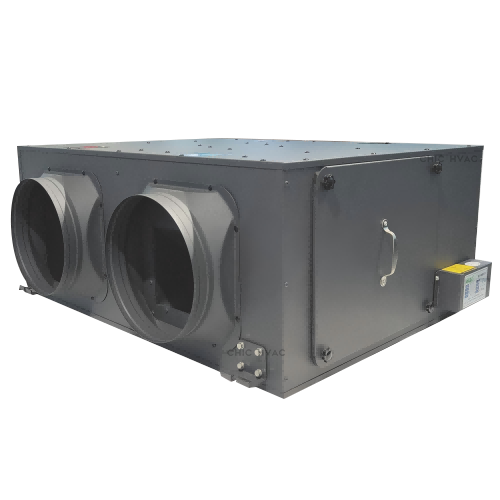
Commercial routeCommercial Fresh Air Ventilator
Commercial ducted fresh air. Airflow and installation depth.
View product details
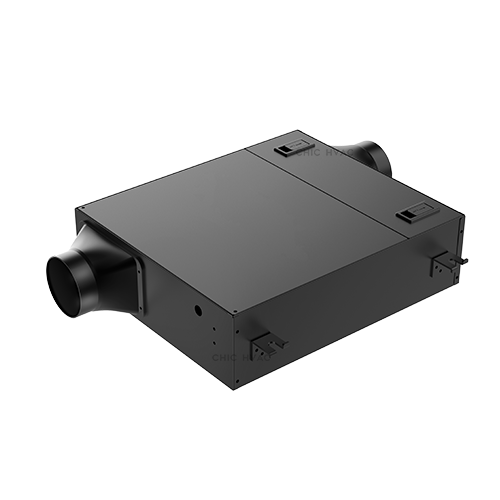
Inline routeSingle Way Fresh Air Inline Fan
Inline fresh-air duct runs. Layout, noise and power.
View product details
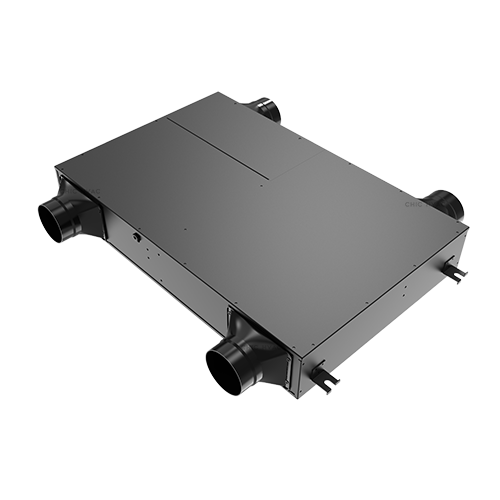
Residential routeHome Fresh Air Ventilator
Residential ducted fresh air. Airflow, controls and space.
View product details
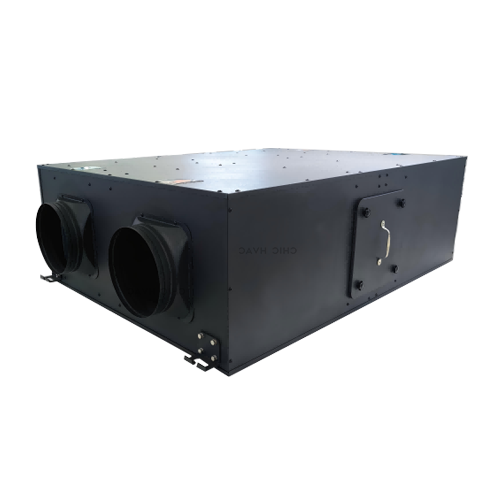
Commercial ERVCommercial Energy Recovery Ventilator
Balanced ventilation for larger projects. 1,000–8,000 m³/h.
View product details
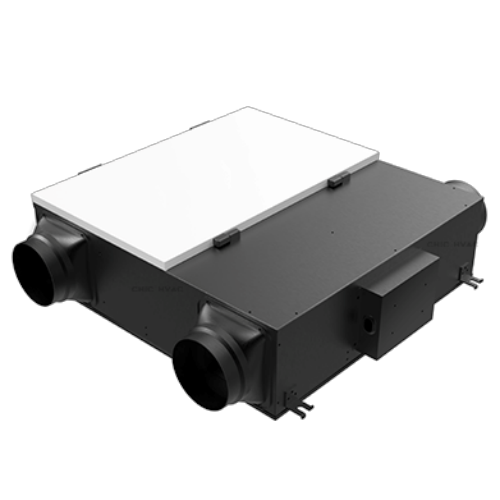
Home ERVHome Energy Recovery Unit
Whole-home heat recovery. QRXF 150–500.
View product details
ERV AND HRV SELECTION
ERV and HRV systems: how to specify heat recovery ventilation
An ERV system (energy recovery ventilator) and an HRV system (heat recovery ventilator) both bring treated fresh air into a building while recovering energy from the air they exhaust. The difference is what they transfer. An HRV recovers sensible heat only — it moves temperature between the two airstreams. An ERV also transfers moisture, so the incoming fresh air arrives closer to the indoor humidity level as well. The ERV vs HRV guide works through the building conditions that decide between the two.
Both are balanced systems: they supply and exhaust at the same time. That is what separates heat recovery ventilation from an exhaust fan, where the fan removes air and the replacement air has to enter through a window, a louvre or a fresh air intake vent.
ERV vs HRV: choose by building, not by acronym
- Cold, dry winters. An HRV is normally sufficient where the indoor air is already dry and the task is simply keeping heat in. Recovering sensible heat is the whole job.
- Humid or mixed climates. An ERV normally fits better where incoming air is humid in summer or the building runs air conditioning, because it limits the moisture load the cooling system has to remove.
- Spaces that generate moisture. Bathrooms, kitchens, laundries and pools put moisture into the exhaust air. An ERV transfers part of it back, which matters in both seasons — read the published enthalpy figures rather than assuming.
- Indoor pools and process spaces. Confirm the core material and construction against the duty before selecting. Not every unit is specified for that exposure.
Energy recovery wheel and fixed core: what the two designs do
An energy recovery wheel is a rotary exchanger: a rotating matrix passes through the exhaust and supply airstreams in turn, carrying heat and moisture across with it. A fixed core — a plate or ceramic element — has no moving part and transfers across a stationary surface. The single-room units below use a fixed ceramic core. An energy recovery wheel HVAC specification of this kind is normally used where very large air volumes are handled and continuous rotation is acceptable; a fixed core is normal in single-room and ducted residential formats. Where a project calls for a rotary wheel, confirm the exact model and core type with the factory before specifying.
What the published figures mean
Three values decide most selections. All three are published per model on the product pages rather than estimated here.
- Airflow. The duty point in m³/h, read at the speed stage you intend to run. A range of speeds is not a range of models: the low stage and the high stage are different duty points.
- Heat exchange efficiency. The share of recoverable energy transferred. It applies to a stated condition, so quote it together with the model and the core.
- Static pressure and noise. Pressure decides whether the unit can push air through the duct route; noise decides whether that speed stage is usable in the room. Both are published per stage.
Published single-room HRV data (VT100 / VT125 / VT501-WiFi)
All three single-room units use a ceramic core, publish heat exchange efficiency up to 90%, and are rated for a transported air temperature range of -20°C to +50°C. Confirm the exact model row and version before ordering; the values below are the source values published on each product page.
| Parameter | VT100 | VT125 | VT501-WiFi |
|---|---|---|---|
| Voltage | 100–240 V 50–60 Hz | 12 VDC or 100–240 V 50–60 Hz | 12 VDC or 100–240 V 50–60 Hz |
| Power by speed | 2.5 / 3.0 / 3.5 / 3.8 W | 2.5 / 6.0 / 8.5 / 12 W | 2.5 / 3.0 / 4.5 / 8.5 W |
| Airflow | 20 / 30 / 40 / 50 m³/h | 20 / 30 / 45 / 60 m³/h | 20 / 48 / 54 / 60 m³/h |
| Speed | 1000 / 1500 / 2000 / 2500 RPM | 630 / 1200 / 2050 / 2900 RPM | 630 / 1100 / 1600 / 2200 RPM |
| Installation tube / wall depth | — | — | 250–500 mm |
| Heat exchanger core | Ceramic | Ceramic | Ceramic |
| Heat exchange efficiency | up to 90% | up to 90% | up to 90% |
The single-room HRV selection guide sets out the five checks — airflow, wall depth, voltage, control and noise — and covers VT100, VT125 and VT501-WiFi individually.
Published whole-home ERV data (QRXF 150–500)
The Home Energy Recovery Unit range is a ducted energy recovery ventilator for home duty, published on 220 V / 50 Hz across four model rows. It carries both exchange-efficiency and enthalpy figures, which is what makes it an ERV rather than an HRV.
| Model | Power high / low | Airflow high / low | Static pressure high / low | Exchange eff. cooling / heating (high) | Enthalpy cooling / heating (high) | Noise high / low | Duct | Area |
|---|---|---|---|---|---|---|---|---|
| QRXF-150 | 100 / 76 W | 150 / 120 m³/h | 200 / 170 Pa | 63% / 78% | 64% / 68% | 37 / 35 dB | φ100 | 80 m² |
| QRXF-250 | 150 / 132 W | 250 / 180 m³/h | 210 / 185 Pa | 62% / 77% | 64% / 67% | 41 / 39 dB | φ150 | 80–100 m² |
| QRXF-350 | 200 / 160 W | 350 / 250 m³/h | 230 / 200 Pa | 62% / 78% | 61% / 67% | 41 / 39 dB | φ150 | 100–130 m² |
| QRXF-500 | 230 / 177 W | 550 / 400 m³/h | 255 / 240 Pa | 61% / 70% | 64% / 69% | 42 / 40 dB | φ200 | 150–200 m² |
Every row also publishes primary filtration at 76.1% and high-efficiency filtration at 99.9%. Net weight runs from 25.3 kg on the QRXF-150 to 32.2 kg on the QRXF-500.
Commercial ERV and ductless formats
For larger projects the commercial energy recovery ventilator range is published from 1,000 to 8,000 m³/h, and the commercial fresh air ventilator covers ducted commercial supply where duct route, installation depth and noise limits drive the choice. Where a wall opening is available and no ductwork is wanted, a single-room unit is the ductless ERV route in this range: the VT100, VT125 and VT501-WiFi mount through a wall tube rather than into a duct system.
ERV HVAC integration, installation and commissioning
An ERV is a ventilation component, not a substitute for heating or cooling. In an ERV HVAC layout it runs alongside the heating and cooling equipment: it delivers treated fresh air and the space conditioning system carries the remaining load. Size the ventilation to occupancy and room volume, then confirm the conditioning equipment still covers what is left. The fresh air intake HVAC detail matters as much as the unit — the intake position, the terminal and the frost protection all change the delivered airflow.
Two steps decide whether a unit performs as published after it is installed.
- ERV installation. The same steps apply whether the drawing is titled energy recovery ventilator installation, heat recovery ventilator installation or HRV installation, because the ductwork is what decides the delivered airflow. Mount the unit level, keep the duct route as short and straight as the design allows, seal every joint on both airstreams, and insulate the duct runs passing through unconditioned space. Condensate, where present, needs a drain route and a fall in the right direction.
- Commissioning and balancing an HRV. In any ventilation and heat recovery installation — a single-room unit or a full HRV heat recovery ventilation system — a balanced system supplies and exhausts equal volumes. Setting the speed stages without checking the balance leaves the building under pressure or over pressure, which changes both the airflow actually delivered and the energy recovered. Measure both airstreams at commissioning and record the settings so the system can be re-checked later.
Confirm the control version, the filtration stage and any frost-protection behaviour for the local climate before ordering, and check the published figures against the delivered model row. The inline duct fan vs HRV / ERV comparison covers where a simple inline fan is the better answer instead.
ERV terminology, in one place
These terms get used interchangeably in tender documents, which is where specification errors start.
- ERV (energy recovery ventilator) — written as ERV unit HVAC, ERV system HVAC or hvac erv on drawings. If the question is what is an energy recovery ventilator, or the shorter what is ERV or what is ERV in HVAC, the answer is the one above. The phrase erv energy recovery ventilator is a redundancy, not a second product. If the question is what is an ERV in HVAC, the answer is the same one: a balanced ventilator that recovers energy from the exhaust airstream. The plural ERV systems usually means more than one unit or more than one zone.
- Energy recovery ventilation system — the complete installation: unit, ductwork, terminals, controls and commissioning.
- Energy recovery unit — the unit alone, without the duct system. Written on drawings as energy recovery unit HVAC; energy recovery ventilators and heat recovery ventilators are the plural forms.
- HRV heat recovery system, HRV ventilation system, heat recovery ventilation system — the heat-only equivalent, and the subject of the hrv vs erv comparison. A hrv hvac line on a drawing means the same unit.
- ERV for home and home ERV — residential duty, where the formats run from single-room wall units up to ducted whole-home units.
- ERV ventilation versus exhaust-only ventilation — the balanced supply-and-extract arrangement is the distinguishing feature.
An HRV heating system is not a heating appliance: it recovers heat from the exhaust air, it does not generate it. Where a tender lists heat recovery unit residential services, that is the scope of work it refers to.
Fresh air ventilation system for home: what to send with an enquiry
For a residential fresh air ventilation system, send the floor area and ceiling height of each zone, the number of occupants, which rooms are served, wall or duct availability, the voltage supply, the climate and the noise limit for bedrooms. For commercial work, add occupancy, the required air changes, the duct route and the document requirements for the destination market. With those details the correct ERV or HRV family, and the exact model row, can be confirmed rather than assumed.
CERTIFICATES
Documents & Compliance
View documents and compliance notes
Check the current buyer-facing ERV document path before tender, distributor review or customs preparation. Product pages still require exact model and destination-market confirmation.
- Document hub Review verified certificates by product scope in the central document hub.
- Model matching Confirm airflow, heat-recovery type, voltage, control version and installation form.
- Use rule Match the exact ERV model before tender or customs use.
Document availability and scope depend on the exact ERV model and destination market. Request a model-specific document check before a project compliance claim.
GUIDES
Selection guides for this range
Request a Quote for Energy Recovery Ventilator
Send your application, required capacity or airflow, installation conditions, quantity, destination market and document requirements. We will confirm the appropriate product family and exact model.
 English
  Русский
  Français
  Deutsch
  Italiano