
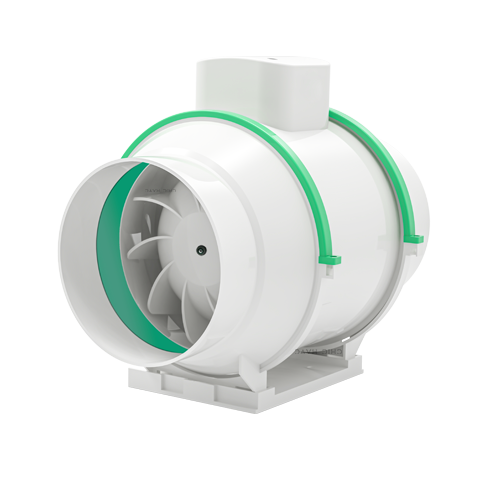
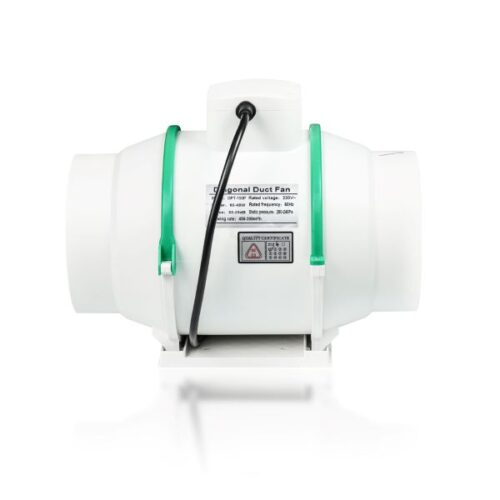
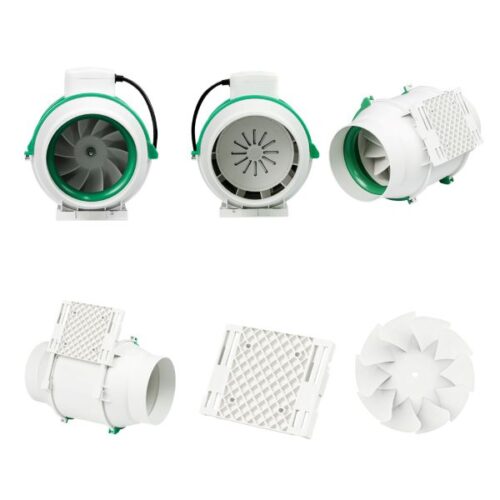



Mixed Flow Inline Fan | Compare DPT Noise and Pressure
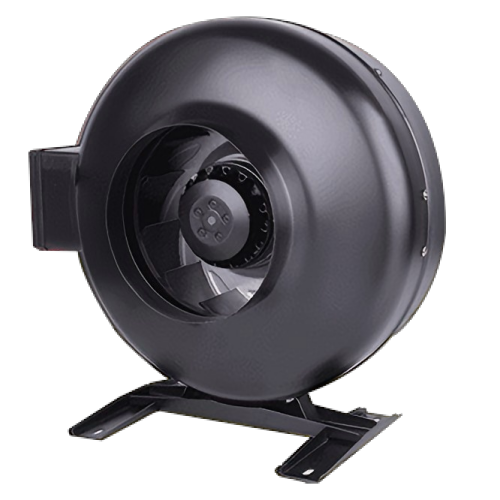
Mixed-flow inline ventilation for duct routes. Compare published noise and static pressure by DPT model before selection.
- Project fit
- Mixed-flow inline ventilation for supply or exhaust duct routes.
- Model range
- 5 models · mixed-flow impeller · published noise and high-pressure inline duct performance

Start with the published model data
Compare the published airflow, static pressure and duct-size rows below. Final selection should match the installed duct route, voltage and quantity.
DPT model performance
Published values for the selectable DPT models at 220 V / 50 Hz. High and Low rows identify the available operating gear where applicable.
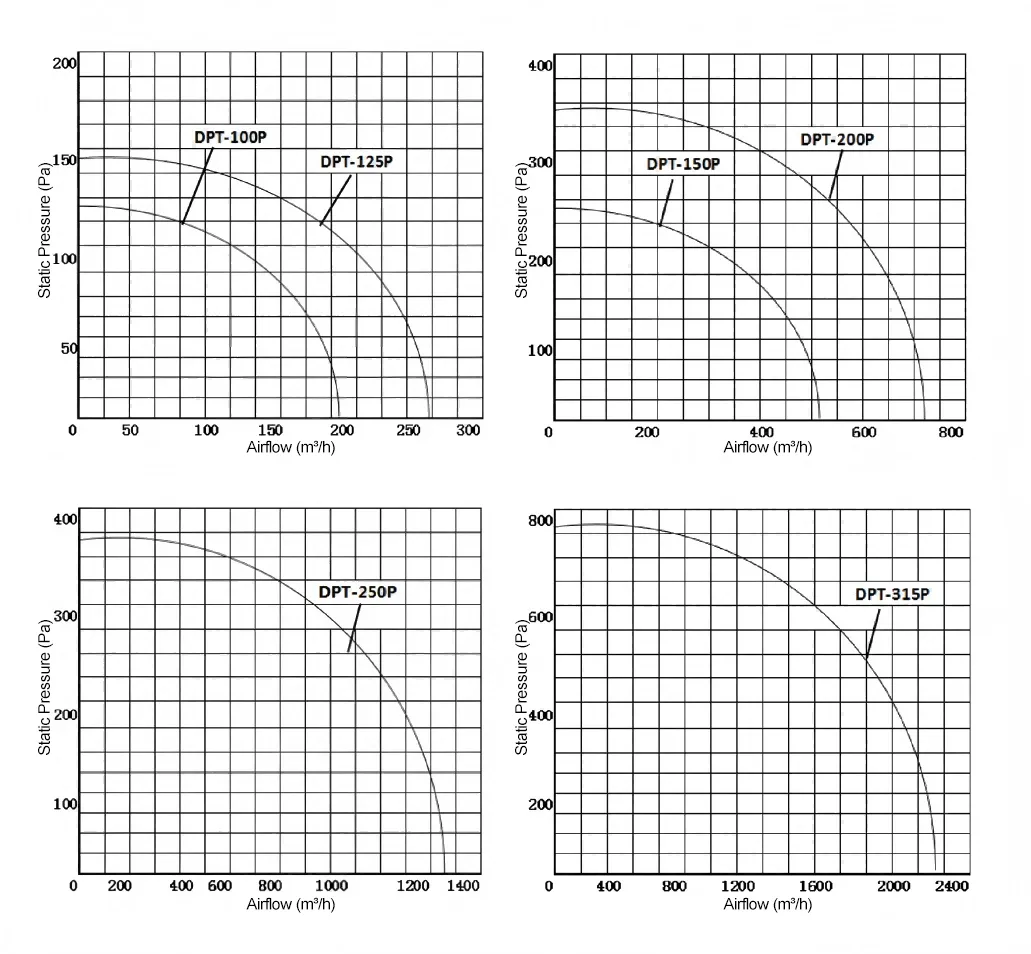
High / Low rows show the published operating gears. DPT-250P and DPT-315P are published as single-gear models.
| Model | Operating gear | Power (W) | Airflow (m³/h) | Static pressure (Pa) | Speed (rpm) | Noise (dB) | Net weight (kg) | Duct size (mm) |
|---|---|---|---|---|---|---|---|---|
| DPT-100P | High | 40 | 204 | 132 | 2400 | 31 | 1.55 | φ100 |
| DPT-100P | Low | 30 | 160 | 106 | 1950 | 26 | 1.55 | φ100 |
| DPT-150P | High | 60 | 450 | 280 | 2590 | 33 | 2.5 | φ150 |
| DPT-150P | Low | 48 | 360 | 240 | 1950 | 29 | 2.5 | φ150 |
| DPT-200P | High | 145 | 840 | 350 | 2490 | 63 | 3.1 | φ200 |
| DPT-200P | Low | 125 | 690 | 270 | 1980 | 55 | 3.1 | φ200 |
| DPT-250P | Single | 230 | 1400 | 489 | 2450 | 66 | 7.5 | φ250 |
| DPT-315P | Single | 360 | 2200 | 690 | 2350 | 69 | 10.4 | φ315 |
Use the airflow-static pressure curve together with the installed duct route to verify the operating point before quotation.
Dimensions (mm)
DPT dimensions by model
| Model | L | W | H | E |
|---|---|---|---|---|
| DPT-100P | 257 | 180 | 215 | φ99 |
| DPT-150P | 302 | 210 | 245 | φ148 |
| DPT-200P | 302 | 230 | 270 | φ198 |
| DPT-250P | 390 | 280 | 310 | φ248 |
| DPT-315P | 450 | 320 | 413 | φ313 |
What a mixed flow fan is, and when it is the right choice
A mixed flow impeller combines two airflow principles in one wheel. It moves air axially along the duct, as an axial fan does, while the shaped blades also accelerate the air outward as a centrifugal fan would. The result sits between the two types: more static pressure than a plain axial fan, in a shorter and more compact body than a centrifugal unit.
That combination is why the mixed flow duct fan format is common in ducted ventilation. Where an axial fan would lose performance against a longer duct run or a filter, and a centrifugal fan would need more room to install, an inline mixed flow fan can be fitted directly into the duct while still developing the pressure the run requires.
How to tell whether a mixed flow fan is the right fit
- Duct length and bends. Short, open runs suit an axial fan. Once the run is long or has several bends, the pressure demand rises and a mixed flow or centrifugal fan becomes the better fit.
- Available space. A mixed flow inline fan sits in the duct line, so it needs no separate plant space or bulky housing. A centrifugal fan may move more air at high pressure, but it needs the room to do it.
- Noise sensitivity. Because the impeller does more of the work internally, the sound profile differs from an axial fan. Where the duct passes occupied space, compare the published noise figure for the specific model rather than a family average.
- Airflow target. Read the published airflow and static pressure together. A model rated at a high free-air airflow can still underperform if the duct resistance is higher than its pressure figure allows.
Mixed flow inline fan, mixed flow duct fan or inline mixed-flow duct fan?
These names describe the same product family, and buyers use them interchangeably. A mixed flow inline fan, a mixed flow duct fan, an inline mixed-flow fan and an inline mixed-flow duct fan all refer to a fan whose impeller combines axial and centrifugal airflow and which mounts within the duct line. If a specification or a supplier uses one of these terms, confirm the duct diameter, the airflow and the static pressure — those three values decide whether the unit works in the installation, not the wording of the name.
If the format is still open, the comparison guide Inline Duct Fan vs Mixed-Flow Fan sets out where each type fits. Where sound is the deciding factor, review the silent mixed flow inline duct fan series instead.
Where this inline duct fan fits
View application fit and project inputs
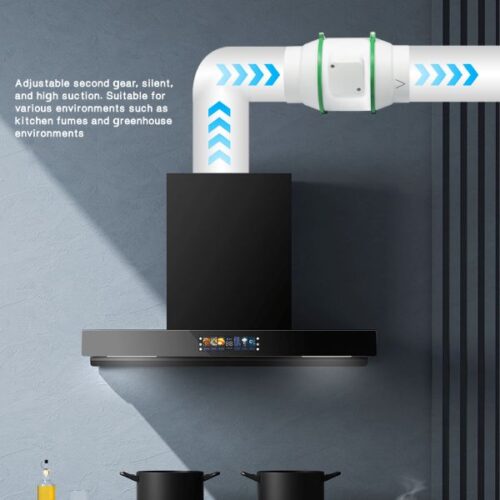
Mixed Flow Inline Fan is suited for low-noise, high-pressure duct ventilation on supply or exhaust routes where the buyer needs compact inline installation and a defined duct path.
For long duct runs, multiple bends, filter resistance or strict noise targets, confirm static pressure instead of selecting by nominal airflow only.
Core Engineering Features
DPT model performance set against the published values on this page. Every point below is taken from this model’s own data.
Quality Assurance & Warranty
Fan orders are checked at the factory before shipping, because published airflow and pressure only hold if the delivered unit matches its table row.
Applied to this model: Operating gear High, Power (W) 40. These checks are run against that specification before the unit ships.
OEM/ODM & Supply Options
For distributors and contractors working on ventilation projects, the supply side adapts to your market instead of one fixed fan build.
For this model (Operating gear High, Power (W) 40), the OEM route can start from that base specification rather than a blank sheet.
Documents & Compliance
Download the KC mixed flow inline fan datasheet used for the technical values on this page, and review the relevant compliance documents.
Confirm the exact model, destination-market requirements and current documentation before quotation or project documentation.
View all certifications and compliance documents by product scope
Frequently asked questions
Read the selection FAQ
Can I choose by duct diameter only?
No. Duct diameter is only the starting point. Confirm airflow, static pressure, duct length and bends.
Why confirm static pressure?
Long ducts, filters and bends reduce actual airflow. Static pressure helps avoid under-selection.
What information is needed for quote?
Send duct diameter, route, airflow target, duct length, bends, outlet type, voltage/frequency, quantity and destination.
Related products
Adjacent models customers compare before deciding. Open a card to see its own published specifications.
QUOTE ROUTE
Request a review for your selected DPT model
Send the selected model, duct conditions and quantity for technical review.
Final quote review requires confirmation of the model, operating mode and installation requirements.
 English
  Русский
  Français
  Deutsch
  Italiano