
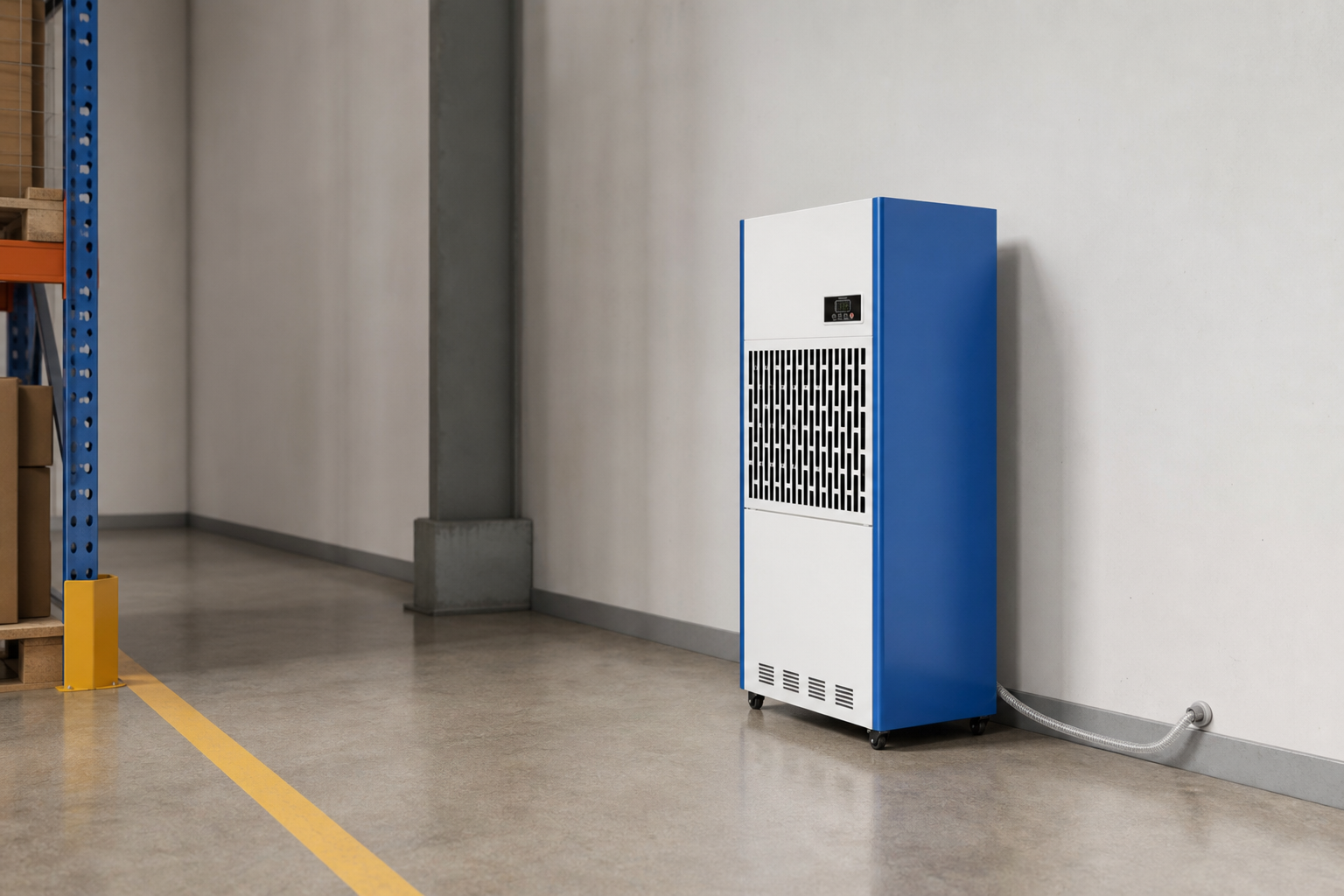
Industrial vs Household Dehumidifier: How to Choose
Industrial vs household dehumidifier: how the two classes differ, how to size by moisture load rather than room area, and published HT-DG series reference data from 60 to 480 L/D.

Industrial vs Household Dehumidifier: How to Choose
The difference between an industrial dehumidifier and a household dehumidifier is not marketing. It comes down to capacity, duty cycle and construction. A household unit removes a few litres per day and is designed for intermittent use in a domestic room. An industrial dehumidifier removes tens to hundreds of litres per day, runs continuously, and is built to hold a target relative humidity in a workshop, warehouse, basement or process area. Choosing the wrong class means either an under-performing unit that never reaches the target, or an oversized unit that wastes energy.
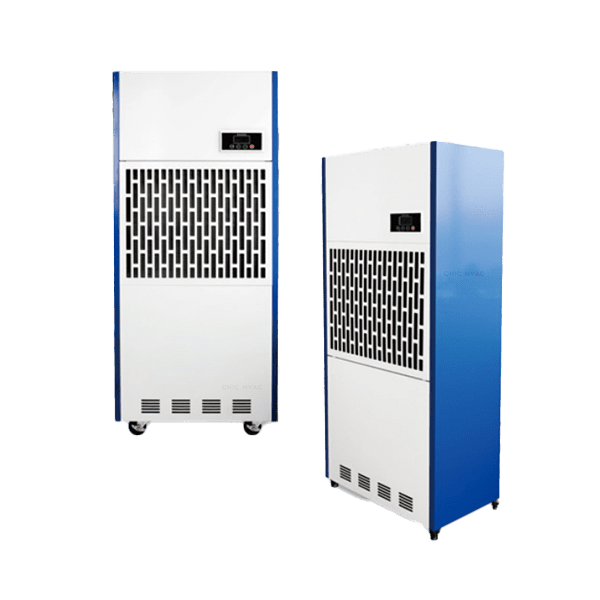
Industrial dehumidifier HT-DG240A1 (240 L/D, 380 V three-phase). Larger models require three-phase supply and continuous drainage.
Quick Answer: Size by moisture load, not by room area. Add up the water entering the space (people, open water, wet processes, air infiltration, drying) in litres per day, add a margin, and choose a unit whose published dehumidification capacity exceeds that load at the working temperature. Household units suit a damp domestic room; industrial units suit continuous moisture control where the load is high or the space is large.
Note: values below are taken from the published industrial dehumidifier data on this site. They describe each model and are not a site-specific performance guarantee. Confirm the exact model against its datasheet before ordering.
What actually separates the two classes
| Factor | Household dehumidifier | Industrial dehumidifier |
|---|---|---|
| Capacity | Often a few L/day | Tens to hundreds of L/day |
| Duty cycle | Intermittent | Continuous / 24-7 |
| Construction | Light, mobile, plastic | Heavier, serviceable, industrial housing |
| Drainage | Often a small tank | Continuous drainage |
| Working range | Comfort conditions | Wider, including cooler spaces per model |
| Typical place | A room in a home | Workshop, warehouse, basement, process room |
| Control | Simple humidistat | Target-RH control for a defined space |
The single most important practical difference is that industrial units are specified to hold a target relative humidity in a defined volume, continuously, which is what a workshop, warehouse or storage area actually needs.
Size by moisture load, not by room area
Manufacturers and buyers often quote a “suitable area” figure, but area alone is misleading because it ignores how much water is present. A better method is to estimate the daily moisture load in litres per day:
- Air infiltration: humid outdoor air entering through doors, vents and gaps. This is often the largest term in a leaky industrial building.
- People: roughly 1–2 litres per person per day for light activity.
- Wet processes and open water: washing, tanks, drains, wet floors.
- Drying: wet materials, freshly poured concrete, or product drying.
- Product / storage: hygroscopic goods that release moisture.
Sum these to get the load, add a safety margin (commonly 20–30%), then choose a dehumidifier whose published capacity at the working temperature exceeds it. For a fuller walk-through, see the industrial dehumidifier capacity sizing guide.
Published industrial dehumidifier data (reference)
This range spans small single-phase units through large three-phase machines. Note the step change in supply: the larger models require 380 V three-phase and should be planned with the circuit and drainage in mind.
| Model | Dehumidification | Input power | Airflow | Voltage | Size (mm) |
|---|---|---|---|---|---|
| HT-DG60A1 | 60 L/D | 680 W | — | AC 220 V / 50 Hz | 380×420×635 |
| HT-DG90A1 | 90 L/D | 1,200 W | 420 m³/h | AC 220 V / 50 Hz | 410×385×915 |
| HT-DG138A1 | 108 L/D | 1,300 W | 550 m³/h | AC 220 V / 50 Hz | 410×385×915 |
| HT-DG240A1 | 240 L/D | 2,600 W | 2,200 m³/h | AC 380 V / 50 Hz | 705×410×1600 |
| HT-DG480A1 | 480 L/D | 8,500 W | 4,200 m³/h | AC 380 V / 50 Hz | 1200×410×1600 |
| HT-15NE1 (constant-temperature) | 10 kg/h | 3.7 kW | 4,800 m³/h | AC 380 V / 50 Hz | 800×600×1850 |
Source: published HT-DG series data. The HT-15NE1 is a constant-temperature dehumidifier rated in kg/h. Capacity is temperature-dependent . Confirm the published value at your working condition.
Reading the range: matching model to duty
- Small room or light load (≈60–90 L/D): HT-DG60A1 or HT-DG90A1: single-phase 220 V, easy to place and drain.
- Medium workshop or store (≈108 L/D): HT-DG138A1: still single-phase, more margin.
- Large warehouse (≈240 L/D): HT-DG240A1: moves to 380 V three-phase; plan power and drainage.
- Very large space or high load (≈480 L/D): HT-DG480A1: high capacity, three-phase.
- Constant temperature + dehumidification (10 kg/h): HT-15NE1: where both temperature and humidity must be controlled, such as a process or storage room.
Need this sized for your project?
Send the required airflow, static pressure, supply and installation details. We shortlist the exact model and confirm the duty point before quotation.
When an industrial dehumidifier is the wrong choice
- A single small domestic room: a household unit is cheaper, quieter and sufficient; an industrial unit would be oversized.
- Capacity quoted for a different temperature: dehumidifier capacity falls at lower temperatures. A unit that meets the load at 30 °C may not at 15 °C. Always read the value at the working condition.
- No continuous drainage plan: industrial units run long; without a drain route they stop or overflow. Plan continuous drainage.
- Wrong power supply: the larger models need 380 V three-phase; confirm the site supply and breaker capacity before ordering.
Frequently asked questions
How do I know what capacity I need?
Estimate the daily moisture load in litres per day (infiltration + people + wet processes + drying), add a 20–30% margin, and choose a unit whose published capacity at the working temperature exceeds it. Area alone is not a reliable basis.
Is a bigger dehumidifier always better?
No. An oversized unit cycles inefficiently and costs more. Size to the load with a sensible margin. Also check the capacity at the actual working temperature, because published capacity is temperature-dependent.
Can an industrial dehumidifier run continuously?
Yes. Continuous duty is one of the main differences from household units, which are typically intermittent. Continuous operation is why drainage planning and the correct power supply matter.
Can Linggongshare recommend the exact model?
We can shortlist models once the room volume, moisture sources, target relative humidity, working temperature and available power are known. Final selection should be confirmed against the model datasheet.
Plan your moisture-control project with Linggongshare
Linggongshare supplies industrial dehumidifiers, air curtains, portable air conditioners, duct fans and heaters. To request a quote, send the room volume, moisture sources, target humidity, working temperature, supply voltage and destination market. Browse the industrial dehumidifier hub or the dehumidifier series hub, or contact us for project support.
Published: 11 September 2026. Reviewed for consistency against the published HT-DG series data.
 English
  Русский
  Français
  Deutsch
  Italiano