
Warehouse Heater Sizing: Electric vs Oil-Fired vs PTC
How to size a workshop or warehouse heater: heat load, electric vs oil-fired vs PTC, coverage area and power supply, with published LG and LHWS data.

Warehouse Heater Sizing: Electric vs Oil-Fired vs PTC
Sizing a workshop or warehouse heater is a heat-load calculation first and a product choice second. Once you know the kilowatts the space needs, the fuel or supply available on site usually narrows the choice to one family. This guide works through the heat load, then compares the electric, oil-fired and PTC options published on this site, with their reference data.
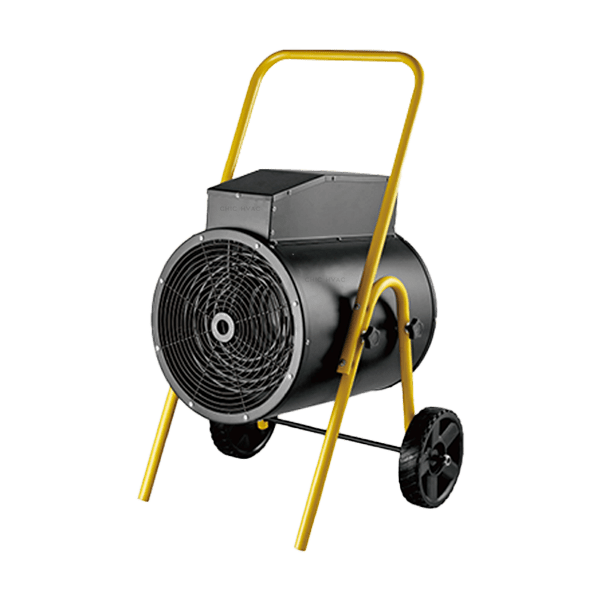
Industrial electric heater fans. Electric heating is the simplest to install where the supply allows; oil-fired units make sense where the electrical supply cannot carry the load.
Quick Answer: work out the required heating power in kW from the space volume, the temperature lift and the insulation quality, then match it to the supply you have. Electric heater fans here run from 1.8 kW to 30 kW and PTC models from 1 kW to 3 kW; oil-fired units suit larger spaces where the electrical supply cannot carry an electric load. Airflow matters as much as power — a heater has to move the warmed air to where people actually work.
Note: the values in this guide come from the published heater data on this site and describe those families. Confirm any specific model against its own datasheet before you order.
Step 1. Estimate the heat load
The starting point is the power needed to hold the space at the target temperature on the coldest day of the design. In practice that comes down to three things: the volume of the space, the temperature lift you want (indoor target minus outdoor design temperature), and how well the building holds heat. As a rough planning figure for a lightly insulated industrial space, around 20 W per cubic metre can be used to hold a moderate lift; a well-insulated space needs less, and a leaky one with large doors needs considerably more. Treat that as a starting point to be confirmed, not an engineering result.
Two practical checks on top of the volume figure. First, if large doors open often, the infiltration load can dominate — factor it in or the space will never reach temperature. Second, radiant losses through an uninsulated roof or single-skin wall can be large; insulation improvement is often cheaper than more kilowatts.
Step 2. Choose between electric, oil-fired and PTC
Electric heater fan
An electric heater fan is a heating element with a fan behind it. It is the simplest to install, needs no fuel storage and no flue, and starts instantly. Its limit is the electrical supply: above a certain power the load needs a three-phase supply and a dedicated circuit. At the upper end of the range here, LG-D15/D30 industrial units cover workshop and warehouse duties where three-phase is available.
Oil-fired heater
An oil-fired heater burns fuel to make heat, so it delivers a large output without a large electrical supply. That is its whole reason for existing: where the site cannot take a big electric load, or where the space is large and open, oil-fired heating is the practical option. The trade-offs are fuel storage, a flue or exhaust path, and a slower response than electric.
PTC heater fan
PTC (positive temperature coefficient) elements self-limit their temperature, which makes them safer for smaller, attended spaces. The published PTC models here are compact units for rooms of around 20–30 m², not for large warehouses. They suit offices, workshops and small rooms where a simple plug-in or single-phase heater is enough.
Step 3. Match power to the supply
Confirm the supply before choosing a model. The published electric heater families span single-phase domestic units and larger industrial units, and the bigger duties need three-phase. If the site has only single-phase, that bounds the electric option and pushes larger duties towards oil-fired heating. Never size on power alone without checking the phase, frequency and circuit capacity you actually have.
Step 4. Check airflow and throw
A heater that makes heat but does not move it leaves the far end of the space cold. Check the published air volume: a larger air volume spreads the heat further and reduces stratification, where warm air sits under the roof while the working level stays cold. In tall spaces, airflow and throw direction matter as much as the kilowatt figure.
Published heater data (reference)
The table below reproduces the published values for the heater families on this site.
| Family | Model | Supply | Power | Air volume | Reference area |
|---|---|---|---|---|---|
| PTC heater fan | LG-PTC-D2 | 220 V / 50 Hz | 25 / 1,000 / 2,000 W | 158 m³/h | ≈20 m² |
| PTC heater fan | LG-PTC-D3 | 220 V / 50 Hz | 25 / 1,800 / 3,000 W | 218 m³/h | ≈30 m² |
| Electric heater fan | LG-D3 / D5 / D9 | 220 V single-phase | 3–9 kW class | Published per model | Small workshop / room |
| Industrial electric heater fan | LG-D15 / D30 | Three-phase (industrial) | 15–30 kW class | Published per model | Workshop / warehouse |
| Oil-fired heater | LHWS-2026A | 220 V / 50 Hz | Oil-fired, published rating | Published per model | Large open workshop |
| Diesel heater series | LG-Y20 / Y30 / Y50 | Published per model | Diesel-fired, published rating | Published per model | Large space / site heating |
Source: published heater data on this site. Where a published figure is presented per model or as a class rather than a single number, it is shown in that form rather than averaged into a figure the source does not state. These values describe the families and are not a site-specific guarantee.
Reading the table: an example
Take a 300 m³ workshop that needs to hold a moderate lift over ambient. At the rough planning figure of 20 W per cubic metre that is about 6 kW, before allowing for door losses. That sits in the LG-D3/D5/D9 electric class, which is a single-phase fit. Now take a 1,500 m³ open warehouse: 20 W/m³ is about 30 kW, at the top of the industrial electric range or into oil-fired territory, and at that size the deciding question is usually whether the site can take a 30 kW three-phase load at all. If it cannot, an oil-fired unit does the same job on a much smaller electrical supply. Which one is right is decided by the supply and the door losses, not by the kilowatt figure alone.
Need this sized for your project?
Send us the space volume, the indoor target and outdoor design temperature, the insulation level, the supply available and how often large doors open. We shortlist the heater family and confirm the duty before quotation.
When these heaters are not the right answer
- Whole-building HVAC to a tight tolerance: these are space heaters. If the process needs close temperature control, that is a different duty.
- Explosive or solvent-laden atmospheres: standard models are not specified for hazardous areas. That has to be confirmed for the application.
- Continuous unattended operation in a confined space: combustion-based units have ventilation and installation requirements that must be designed, not assumed.
- Very large, very leaky buildings: the cheapest answer is often insulation and door management before more heating power.
Frequently asked questions
How many kW do I need to heat my workshop?
Start from the volume, the temperature lift and the insulation. Around 20 W per cubic metre is a rough planning figure for a lightly insulated industrial space holding a moderate lift, then add for door losses. Confirm it before ordering.
Electric or oil-fired heating: which should I choose?
Choose electric where the supply can carry the load and oil-fired where it cannot. Oil-fired heating delivers a large output on a small electrical supply, at the cost of fuel storage and a flue.
What is a PTC heater fan used for?
Smaller, attended spaces. PTC elements self-limit temperature, which is a safety advantage in a compact room. The published PTC models here suit around 20–30 m², not a large warehouse.
Are the table values final for ordering?
They are published reference values for the families. For ordering, the exact model nameplate data and your project condition govern. Each product page carries the full published snapshot.
Plan your heating project with Linggongshare
Linggongshare supplies warm-air heaters, cabinet and centrifugal fans, duct fans, exhaust fans, air curtains, dehumidifiers and HRV units. To request a quote, send us the space volume, the target temperature lift, the supply available and destination market. Browse the full product selection hub or the heater series hub, or contact us and we will help you narrow it down.
Published 16 September 2026. Reviewed against the published electric, PTC, oil-fired and diesel heater data.
 English
  Русский
  Français
  Deutsch
  Italiano