
Air Curtain Installation: Height, Width and Air Speed
How to install an air curtain: matching door width and mounting height, choosing air speed for the doorway, positioning and the published model data.

Air Curtain Installation: Height, Width and Air Speed
An air curtain is only as good as its installation. The same unit that seals a doorway perfectly can fail completely if it is mounted at the wrong height, sized to the wrong width, or set at the wrong air speed. This guide covers the installation decisions in the order they matter, with the published model data from this site.
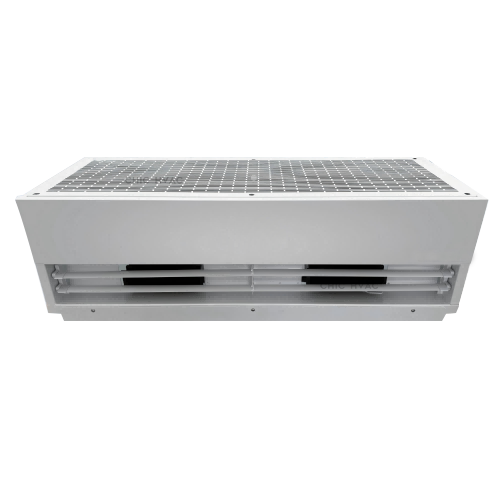
Industrial air curtain. Published air speed and airflow are quoted at the unit; installation height and doorway width decide whether that performance reaches the floor.
Quick Answer: install the air curtain as close to the doorway width as possible, mounted at the height the model is designed for, and set the air speed to reach the floor. The published model range here spans doorways from 600 mm to 2,000 mm and air speeds from 7.5 m/s (elevator units) to 30 m/s (industrial units). Too narrow leaves gaps at the sides; mounting too high lets the air stream dissipate before it reaches the floor.
Note: the values in this guide come from the published air curtain data on this site and describe those families. Confirm any specific model against its own datasheet before you order.
Step 1. Match the unit width to the doorway
The single most important installation decision is width. An air curtain works by projecting a continuous wall of air across the full doorway opening. If the unit is narrower than the door, the uncovered strips at the edges let outside air straight through, and the installation underperforms no matter how powerful the unit is.
Measure the actual clear opening, not the frame, and choose the published model whose width matches. The model list is built around standard door widths — 600, 900, 1,000, 1,200, 1,500, 1,800 and 2,000 mm all appear in the published range. If the doorway falls between two sizes, take the larger one rather than accepting edge gaps.
Step 2. Set the mounting height correctly
Mounting height and air speed are two sides of the same decision. The air curtain has to project its stream from the mounting point down to the floor while still having enough velocity to resist the pressure difference across the doorway. Mount it too high and the stream loses momentum before it reaches the floor; mount it too low and it obstructs the opening.
The published air speed figure is quoted at the unit, so the useful question is always: is this speed enough at this height? That is why a unit with a lower headline speed at a lower mounting height can outperform a faster unit mounted too high. If in doubt, mount at the height the model is designed for rather than improvising.
Step 3. Choose the air speed for the doorway
Air speed is not a “more is better” figure. It has to be matched to the pressure the door faces and the height it must span, and a speed that is too high simply wastes energy and makes noise. The published range on this site spans three broad bands:
- Elevator and light duties: around 7.5 m/s, on compact units and doors with no significant external pressure.
- Cross-flow and commercial duties: around 9–13 m/s, the typical band for shop and office doorways.
- Industrial and high-exposure duties: 16–30 m/s, for large openings, wind exposure and temperature separation.
Match the band to the duty before choosing a model. A commercial doorway does not need a 30 m/s industrial unit, and an exposed loading bay will not be sealed by a 13 m/s unit.
Step 4. Check the supply and the mounting structure
Air curtain families differ widely in power draw, and the larger ones need three-phase supply. The published industrial range runs from 1,350 W to 3,400 W at 380 V; the compact cross-flow and elevator units run from 80 W to 350 W at 220 V. Confirm the supply before selecting, and confirm that the wall or ceiling above the door can carry the unit weight — the published figures run from about 5 kg on compact units to 78 kg on the largest industrial models.
Step 5. Decide heating or unheated
An air curtain can be unheated (air recirculation and door sealing only) or heated (electric, water or gas, adding a temperature lift to the air stream). Choose based on whether the doorway needs to hold temperature for comfort, or simply stop draughts and insects. The published heated range here uses PTC heating with multiple power settings, which is worth knowing if running cost matters over long periods.
Published air curtain data (reference)
The table below reproduces published values across the air curtain families on this site, to show the width, speed and power spread between them.
| Family | Model | Supply | Power | Airflow (m³/h) | Air speed (m/s) | Noise (dB) | Width / size (mm) |
|---|---|---|---|---|---|---|---|
| Elevator (compact) | FM-125-08DT | 220 V / 50 Hz | 80 W | 860 | 7.5 | ≤49 | 800 × 146 × 173 |
| Cross-flow (Q series) | FM-125-06 | 220 V / 50 Hz | 105 W | 1,200 | 9–11 | 50 | 600 × 145 × 185 |
| Cross-flow (Q series) | FM-125-12 | 220 V / 50 Hz | 160 W | 1,700 | 9–11 | 58 | 1,200 × 145 × 185 |
| Cross-flow (Q series) | FM-125-20 | 220 V / 50 Hz | 280 W | 2,900 | 9–11 | 61 | 2,000 × 145 × 185 |
| Cross-flow (B series) | LK-FM4015 | 220 V / 50 Hz | 260 W | 3,580 | 11–13 | 55 | 1,500 × 175 × 210 |
| Cross-flow (B series) | LK-FM4020 | 220 V / 50 Hz | 350 W | 4,280 | 11–13 | 56 | 2,000 × 175 × 210 |
| Centrifugal (X5 series) | LK-FM4509-L/Y | 220 V / 50 Hz | 230 W | 1,100 | 16 | 50 | 900 × 215 × 230 |
| Industrial | FM-6509 | 380 V / 50 Hz | 1,350 W | 4,510 | 30 | 70 | 900 × 352 × 306 |
| Industrial | FM-6515 | 380 V / 50 Hz | 2,700 W | 9,000 | 30 | 72 | 1,500 × 352 × 306 |
| Industrial | FM-6520 | 380 V / 50 Hz | 3,400 W | 11,200 | 30 | 71 | 2,000 × 352 × 306 |
| Heated (PTC, high power) | RM-1209D/Y | 380 / 220 V, 50 Hz | 6 / 4 / 2 kW PTC | 1,000 | 8.0–6.5 | 55 | 900 × 184 × 257 |
| Heated (PTC, high power) | RM-1215D/Y | 380 / 220 V, 50 Hz | 10 / 8 / 6 kW PTC | 1,400 | 8.0–6.5 | 58 | 1,500 × 184 × 257 |
Source: published air curtain data on this site, across the elevator, cross-flow (Q and B series), centrifugal (X5), industrial (FM-65 series) and heated (RM-12 series) families. Air speed is a published figure at the unit; the first dimension is the unit width (doorway it suits). The heated rows publish PTC power settings rather than a single figure, and are shown in that form. These values describe the families and are not a site-specific guarantee.
Reading the table: an example
Say you are sealing a 1,500 mm shop doorway with normal foot traffic and no heavy wind exposure. Run your eye down the width column. FM-125-15 (cross-flow Q series) covers a 1,500 mm doorway at 9–11 m/s on 200 W, quiet at 59 dB. LK-FM4015 (cross-flow B series) also covers 1,500 mm but at 11–13 m/s and 3,580 m³/h on 260 W, which gives a stronger air stream for a busier or more exposed doorway. Now take the same width on a loading bay that faces the weather: FM-6515 covers 1,500 mm at 30 m/s on 2,700 W and three-phase supply, which is the right band for that exposure but needs the electrical infrastructure. Which one is right depends on what the doorway actually faces, and that is a site judgement rather than a catalogue one.
Need this sized for your doorway?
Send us the clear door width and height, what the doorway faces (wind, traffic, temperature difference), whether you need heating, the supply available and the mounting structure. We shortlist the exact model before quotation.
Common installation mistakes
- Unit narrower than the door: leaves edge gaps and lets air straight through. Match the width, and round up rather than down.
- Mounted too high: the air stream dissipates before reaching the floor, so the doorway is not sealed even at full speed.
- Air speed chosen by habit: a commercial unit does not seal an exposed bay, and an industrial unit over a quiet shop door wastes energy and makes noise.
- Supply checked last: the industrial models need three-phase. Confirming the supply after choosing the model can invalidate the whole selection.
- Weight ignored: the largest industrial units are around 78 kg. The mounting structure has to be designed for it.
Frequently asked questions
What height should an air curtain be mounted at?
At the height the model is designed for. Mounting higher lets the air stream lose momentum before it reaches the floor. The published air speed is quoted at the unit, so the installation height is what decides whether that speed still seals the doorway.
Can an air curtain be wider than the door?
It can, and rounding up is preferable to rounding down. An oversized unit can be turned down; an undersized one cannot cover the opening it was not sized for.
Do I need a heated air curtain?
Only if the doorway needs to hold temperature for comfort. An unheated unit still stops draughts, dust and insects. Heated models add a temperature lift at a running cost, so the choice depends on what the space needs.
Are the table values final for ordering?
They are published reference values for the families. For ordering, the exact model nameplate data and your project condition govern. Each product page carries the full published snapshot.
Plan your installation with Linggongshare
Linggongshare supplies industrial, ceiling, cold-storage, cross-flow, centrifugal, elevator and heated air curtains, plus duct fans, HRV units, filters and heaters. To request a quote, send us the doorway dimensions, the exposure, whether you need heating, the supply and the destination market. Browse the full product selection hub or the air curtain hub, or contact us and we will help you narrow it down.
Published 16 September 2026. Reviewed against the published air curtain data across the elevator, cross-flow, centrifugal, industrial and heated families.
 English
  Русский
  Français
  Deutsch
  Italiano