
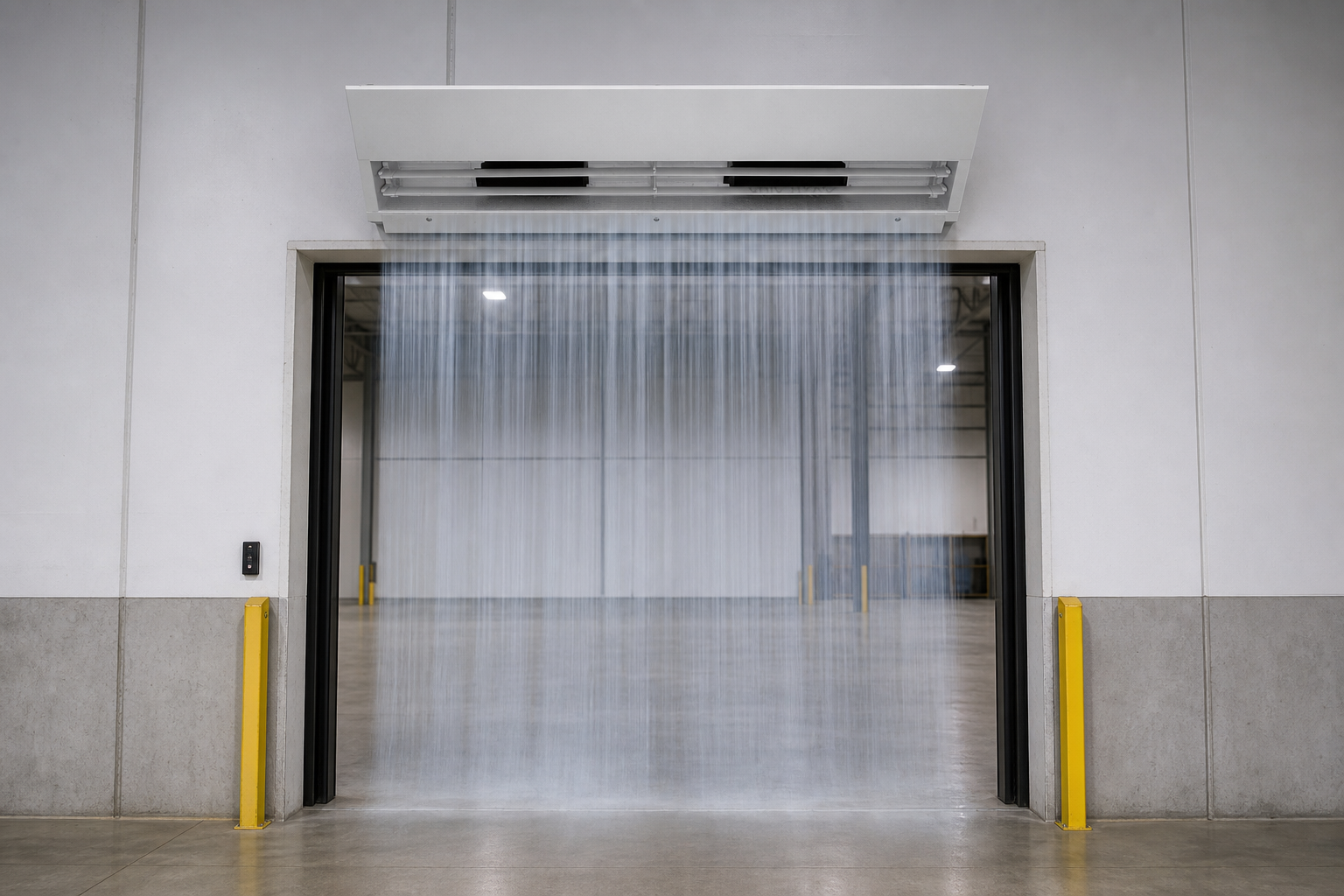
Air Curtain Selection Guide: Door Width, Height, Air Speed and Airflow
How to select an air curtain: match door width, mounting height, air speed and airflow to the doorway, with published reference data for cross-flow, centrifugal and industrial families.

Air Curtain Selection Guide: Door Width, Height, Air Speed and Airflow
When you size an air curtain, three measurements on the door do most of the work. The first is the clear door width, which sets how long the unit has to be. The second is the mounting height above the floor, which sets the discharge air speed you need. The third is how the door is used, and that decides whether ambient or heated air makes more sense. Airflow then follows from length and speed together. Get any one of the three wrong and the unit underperforms. A curtain that is too short leaves an unprotected gap at each side, and one with too little speed at floor level will not hold its barrier against wind, stack effect or vehicles passing through.
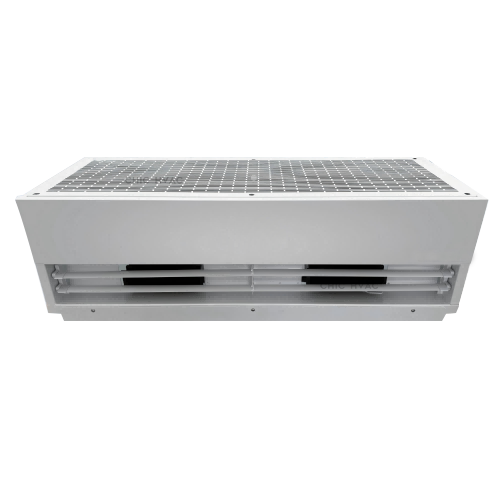
Industrial air curtain for large doorways.
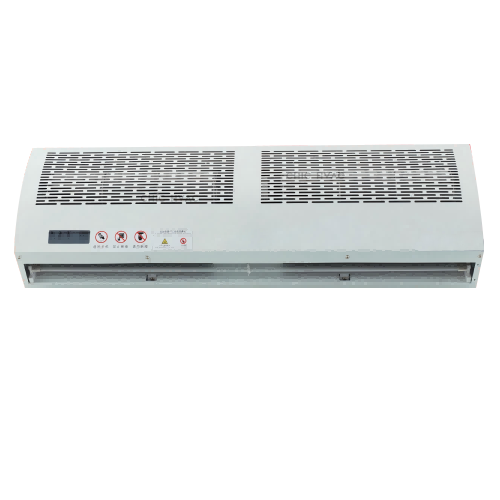
Heated air curtain for cold-climate entrances (RM-12 series with PTC heating).
Quick Answer: measure the clear opening, note the mounting height, then decide between ambient and heated. For a standard door 0.9 to 2.0 m wide mounted 2.3 to 2.5 m above the floor, a 900 to 2000 mm unit with roughly 11 to 17 m/s discharge is typical. Above about 3 m mounting height, or on wide industrial doors, you are into higher-pressure centrifugal or industrial units. The published model data, the building’s pressure conditions and the way the door is used settle the final choice.
Note: the values below come from the published air curtain data on this site and describe each family. They are not a site-specific performance guarantee. Confirm the exact model against its datasheet before ordering.
How an air curtain works
An air curtain pushes a controlled jet of air down across the full width of a doorway, from the top of the opening to the floor. That jet acts as a barrier. It slows the exchange of indoor and outdoor air, which helps keep conditioned or refrigerated air in and keeps dust, insects and untreated outside air out. It is not a physical seal, so people and vehicles still pass through freely. What matters is whether the jet still has useful velocity when it reaches the floor, and whether it is wide enough to cover the whole opening.
The four selection inputs
1. Clear door width sets the unit length
Measure the clear opening, not the structural frame around it. The curtain body needs to span the full opening so the jet covers both edges. If a single unit is shorter than the opening, two or more units can be mounted side by side to cover it. Published lengths in this range usually step in 300 mm increments, such as 900, 1200, 1500, 1800 and 2000 mm.
2. Mounting height sets the air speed
The higher the unit sits, the faster the jet has to leave the nozzle to still reach the floor with useful velocity. As a working guide:
- Up to about 2.5 m: roughly 9 to 13 m/s discharge is common on standard and interior doorways.
- About 2.5 to 3.2 m: roughly 16 to 20 m/s is typical, which usually points to a centrifugal unit.
- High or wide industrial doorways: higher-pressure industrial units with 30 m/s-class discharge and very high airflow may be needed.
These are indicative ranges for a first pass. The model data and the building’s pressure conditions settle the final figure.
3. Ambient or heated air
An ambient curtain recirculates air at room temperature. It is the usual choice for summer cooling loss, cold-storage protection, dust and insect control, and internal doorways. A heated curtain adds electric PTC heating to the discharge, which offsets the cold draught at the door in winter and is common on external entrances in cold climates. Heated models pull significantly more power and need a suitable supply. Published multi-step PTC ratings let the heat output be staged to the weather.
4. Electrical supply
Small cross-flow units are usually single-phase 220 V, while large industrial units are commonly three-phase 380 V. It is worth checking what is actually available at the door before you shortlist anything, because the family options differ by phase and power.
Matching the family to the door
The families below cover the common door sizes and duties. Treat this as a routing table to work out which family deserves a closer look.
| Application | Family | Typical length range | Air speed | Airflow | Supply / power |
|---|---|---|---|---|---|
| Elevator doorway | FM-125-08DT | 800 mm | 7.5 m/s | 860 m³/h | 220 V / 80 W |
| Small doors, shops, internal | Cross-Flow Q series (FM-125) | 600–2000 mm | 9–11 m/s | 1200–2150 m³/h | 220 V / 105–200 W |
| Standard doors, quiet areas | Cross-Flow B series (FM-40) | 900–2000 mm | 11–13 m/s | 1630–4280 m³/h | 220 V / 160–350 W |
| Standard doors, higher reach | X5 Centrifugal (FM-45) | 900–1800 mm | 16 m/s | 1100–2280 m³/h | 220 V / 230–450 W |
| Ceiling-mounted, 2.5–3.2 m | Ceiling industrial (FM-35/40CS) | 900–1500 mm | 16–18 m/s | 1100–1900 m³/h | 220 V / 230–380 W |
| Large industrial doors | Industrial (FM-65) | 900–2000 mm | 30 m/s | 4510–11200 m³/h | 380 V / 1350–3400 W |
| Cold storage / refrigerated | LKFM-25 | 900–2400 mm | 16.5–20 m/s | 1250–1850 m³/h | 380/220 V / 750 W |
| Heated entrance, cold climate | RM-12 (PTC) | 900–1800 mm | 6.5–8 m/s | 1000–1600 m³/h | 380/220 V / PTC 2–12 kW |
Source: published air curtain family data. Lengths and values are family ranges.
Published family data (reference)
Industrial air curtain: FM-65 series
Built for large or high doorways that need a strong, high-velocity barrier. Three-phase 380 V, 30 m/s discharge.
| Model | Dimensions (mm) | Power (W) | Air speed (m/s) | Airflow (m³/h) | Noise dB | Weight (kg) |
|---|---|---|---|---|---|---|
| FM-6509 | 900×352×306 | 1350 | 30 | 4510 | 70 | 35 |
| FM-6512 | 1200×352×306 | 2100 | 30 | 6760 | 71 | 50 |
| FM-6515 | 1500×352×306 | 2700 | 30 | 9000 | 72 | 64 |
| FM-6518 | 1800×352×306 | 2900 | 30 | 10000 | 73 | 67 |
| FM-6520 | 2000×352×306 | 3400 | 30 | 11200 | 71 | 78 |
Cross-flow air curtain: B series (FM-40) and Q series (FM-125)
Quieter, single-phase units for standard entrances and shop doors. Both series step in 300 mm increments, so you choose by width.
| Model | Dimensions (mm) | Power (W) | Air speed (m/s) | Airflow (m³/h) | Noise dB | Weight (kg) |
|---|---|---|---|---|---|---|
| FM-125-06 | 600×145×185 | 105 | 9–11 | 1200 | 50 | 5.5 |
| FM-125-09 | 900×145×185 | 105 | 9–11 | 1300 | 57 | 7 |
| FM-125-12 | 1200×145×185 | 160 | 9–11 | 1700 | 58 | 8.5 |
| FM-125-15 | 1500×145×185 | 200 | 9–11 | 2150 | 59 | 10 |
| FM-4009 | 900×175×210 | 160 | 11–13 | 1630 | 53 | , |
| FM-4012 | 1200×175×210 | 220 | 11–13 | 2500 | 54 | , |
| FM-4015 | 1500×175×210 | 260 | 11–13 | 3580 | 55 | , |
| FM-4018 | 1800×175×210 | 320 | 11–13 | 3900 | 56 | , |
| FM-4020 | 2000×175×210 | 350 | 11–13 | 4280 | 56 | , |
X5 centrifugal series (FM-45) and ceiling industrial (FM-35/40CS)
These centrifugal units reach higher mounting positions with a more concentrated jet (16 to 18 m/s), and they stay single-phase and fairly quiet at 50 to 54 dB.
| Model | Dimensions (mm) | Power (W) | Air speed (m/s) | Airflow (m³/h) | Noise dB |
|---|---|---|---|---|---|
| FM-4509-L/Y | 900×215×230 | 230 | 16 | 1100 | 50 |
| FM-4512-L/Y | 1200×215×230 | 290 | 16 | 1500 | 52 |
| FM-4515-L/Y | 1500×215×230 | 380 | 16 | 1900 | 53 |
| FM-4518-L/Y | 1800×215×230 | 450 | 16 | 2280 | 54 |
| FM-3509CS | 900×320×235 | 230 | 16–18 | 1100 | 49 |
| FM-3515CS | 1500×320×235 | 380 | 16–18 | 1900 | 52 |
Cold storage (LKFM-25) and heated curtain (RM-12)
The cold-storage unit uses a stronger jet and a 380/220 V supply to hold a barrier against the temperature and pressure difference at a refrigerated door. The RM-12 adds multi-step PTC heating for cold-climate entrances.
| Model | Dimensions (mm) | Power | Air speed (m/s) | Airflow (m³/h) | Noise dB |
|---|---|---|---|---|---|
| LKFM-25-09 | 1326×364×426 | 0.75 kW | 20 | 1250 | 70 |
| LKFM-25-15 | 1926×364×426 | 0.75 kW | 18 | 1400 | 70 |
| LKFM-25-20 | 2426×364×426 | 0.75 kW | 16.5 | 1850 | 70 |
| RM-1209D/Y | 900×184×257 | PTC 6/4/2 kW | 8.0–6.5 | 1000 | <55 |
| RM-1215D/Y | 1500×184×257 | PTC 10/8/6 kW | 8.0–6.5 | 1400 | <58 |
| RM-1218D/Y | 1800×184×257 | PTC 12/10/8 kW | 8.0–6.5 | 1600 | <60 |
Source: published air curtain family data. Cold-storage airflow is listed at the upper end of the family range.
Need this sized for your project?
Send us the clear door width, mounting height and supply details. We shortlist the exact model and confirm the duty point before quotation.
When an air curtain is not enough
- Strong cross-wind or a very exposed doorway: an air curtain may struggle to hold a barrier outdoors in strong wind. A vestibule or airlock can be the better answer.
- An opening taller than the unit’s rated reach: a longer unit does not add vertical reach, because discharge speed and mounting height govern that. Step up to a centrifugal or industrial family instead.
- Heavy vehicle traffic through an industrial door: the jet has to resist the pressure pulse of passing vehicles, so industrial 30 m/s-class units are usually specified rather than light cross-flow models.
- Explosive or corrosive atmospheres: standard models are not specified for these. The application and protection requirements need to be confirmed first.
Frequently asked questions
How do I choose between cross-flow and centrifugal?
Cross-flow units are compact, quiet and inexpensive, and they suit standard doors mounted up to about 2.5 m. Centrifugal units produce a more concentrated, higher-speed jet and reach higher mounting positions. Go centrifugal when the door is taller, when you need a stronger barrier, or when the unit will sit above about 2.5 to 3 m.
Does a longer air curtain mean a stronger one?
No. Length covers the door width; strength comes from discharge speed and airflow. A long unit at low speed protects a wide door poorly, and a short unit at high speed leaves the sides of a wide door unprotected. You need both.
Should I choose a heated air curtain?
Choose heated if the doorway is on an external wall and the space has to stay comfortable in winter, or if the cold draught at the door is a problem. Ambient units are usually enough for internal doorways, cooling-loss control, dust and insect control, and cold-storage protection.
Can Linggongshare recommend the exact model?
Yes. Once we know the clear door width, mounting height, ambient or heated requirement and available supply, we can shortlist models. Final selection should be confirmed against the model datasheet and the site’s pressure conditions.
Plan your air curtain project with Linggongshare
Linggongshare supplies air curtains, duct fans, centrifugal fans, exhaust fans, dehumidifiers and heaters for commercial and industrial ventilation. To request a quote, send us the clear door width, mounting height, ambient or heated requirement, supply voltage and destination market. Browse the air curtain selection hub or the full product selection hub, or contact us and we will help you narrow it down.
Published 11 September 2026. Reviewed against the published air curtain family data.
 English
  Русский
  Français
  Deutsch
  Italiano