
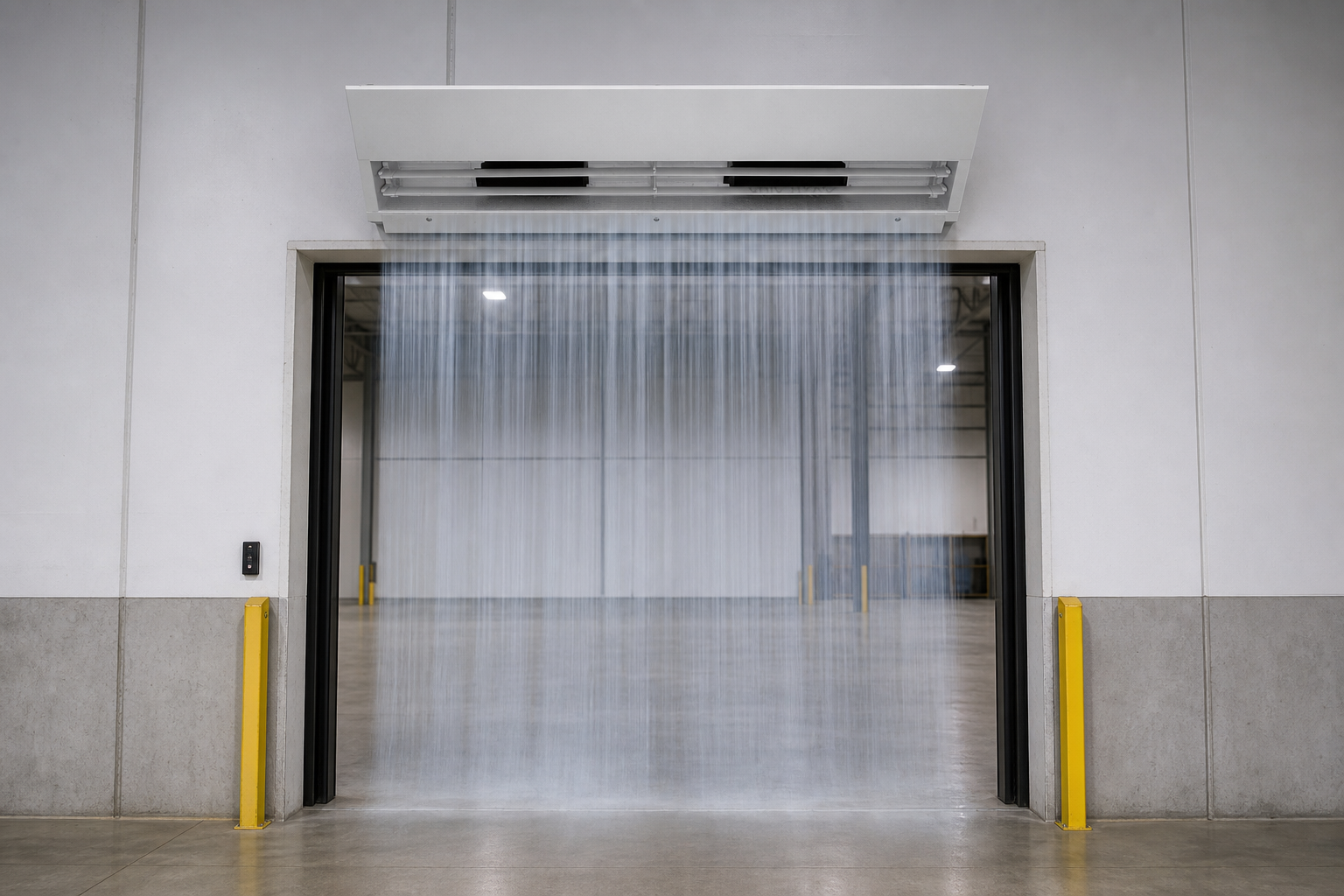
Guida alla scelta delle barriere d'aria: larghezza porta, altezza, velocità e portata
Come selezionare una barriera d'aria: abbinare larghezza della porta, altezza di montaggio, velocità dell'aria e portata d'aria alla porta, con dati di riferimento pubblicati per le famiglie a flusso trasversale, centrifughe e industriali.

Guida alla scelta delle barriere d'aria: larghezza porta, altezza, velocità e portata
Quando si dimensiona una barriera d'aria, tre misure sulla porta fanno la maggior parte del lavoro. La prima è la larghezza libera della porta, che stabilisce quanto deve essere lunga l'unità. La seconda è l' altezza di montaggio dal pavimento, che stabilisce la velocità dell'aria di mandata necessaria. La terza è come la porta viene utilizzata, e questo decide se l'aria ambiente o riscaldata ha più senso. La portata d'aria deriva quindi da lunghezza e velocità insieme. Se una delle tre è sbagliata, l'unità rende meno. Una barriera troppo corta lascia uno spazio non protetto su ciascun lato, e una con velocità troppo bassa a livello del pavimento non manterrà la sua barriera contro vento, effetto camino o veicoli in transito.
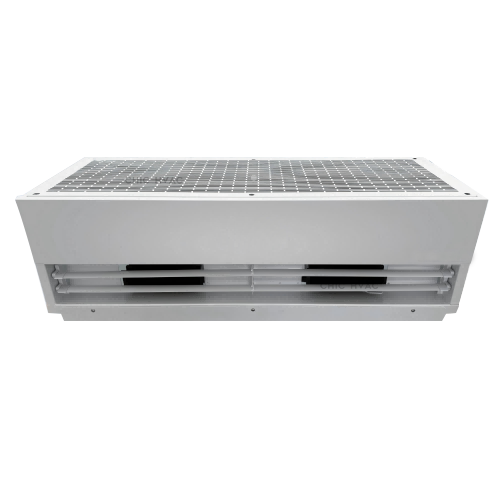
Barriera d'aria industriale per portoni di grandi dimensioni.
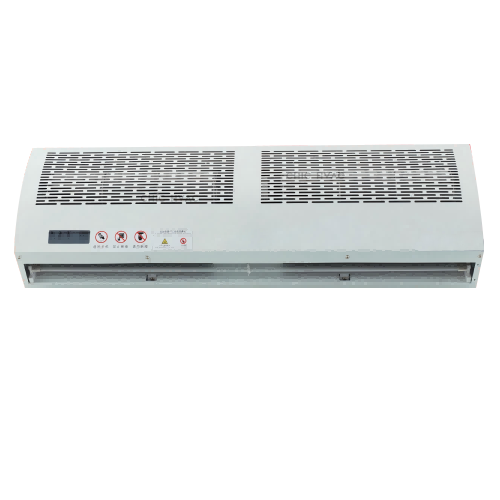
Barriera d'aria riscaldata per ingressi in climi freddi (serie RM-12 con riscaldamento PTC).
Quick Answer: misurare l'apertura libera, annotare l'altezza di montaggio, poi decidere tra aria ambiente e aria riscaldata. Per una porta standard larga da 0,9 a 2,0 m montata da 2,3 a 2,5 m sopra il pavimento, un'unità da 900 a 2000 mm con una mandata di circa 11-17 m/s è tipica. Oltre circa 3 m di altezza di montaggio, o su ampie porte industriali, si passa a unità centrifughe o industriali a pressione più elevata. I dati pubblicati dei modelli, le condizioni di pressione dell'edificio e il modo in cui viene utilizzata la porta determinano la scelta finale.
Nota: i valori seguenti provengono dai dati pubblicati sulle barriere d'aria presenti su questo sito e descrivono ciascuna famiglia. Non sono una garanzia di prestazioni specifica per il sito.
How an air curtain works
An air curtain pushes a controlled jet of air down across the full width of a doorway, from the top of the opening to the floor. That jet acts as a barrier. It slows the exchange of indoor and outdoor air, which helps keep conditioned or refrigerated air in and keeps dust, insects and untreated outside air out. It is not a physical seal, so people and vehicles still pass through freely. What matters is whether the jet still has useful velocity when it reaches the floor, and whether it is wide enough to cover the whole opening.
The four selection inputs
1. Clear door width sets the unit length
Measure the clear opening, not the structural frame around it. The curtain body needs to span the full opening so the jet covers both edges. If a single unit is shorter than the opening, two or more units can be mounted side by side to cover it. Published lengths in this range usually step in 300 mm increments, such as 900, 1200, 1500, 1800 and 2000 mm.
2. Mounting height sets the air speed
The higher the unit sits, the faster the jet has to leave the nozzle to still reach the floor with useful velocity. As a working guide:
- Up to about 2.5 m: roughly 9 to 13 m/s discharge is common on standard and interior doorways.
- About 2.5 to 3.2 m: roughly 16 to 20 m/s is typical, which usually points to a centrifugal unit.
- High or wide industrial doorways: higher-pressure industrial units with 30 m/s-class discharge and very high airflow may be needed.
These are indicative ranges for a first pass. The model data and the building’s pressure conditions settle the final figure.
3. Ambient or heated air
An ambient curtain recirculates air at room temperature. It is the usual choice for summer cooling loss, cold-storage protection, dust and insect control, and internal doorways. A heated La cortina d'aria aggiunge riscaldamento elettrico PTC alla mandata, che compensa la corrente d'aria fredda alla porta in inverno ed è comune sugli ingressi esterni nei climi freddi. I modelli riscaldati assorbono significativamente più potenza e richiedono un'alimentazione adeguata. I valori nominali PTC multi-livello pubblicati consentono di modulare la potenza termica in base alle condizioni meteorologiche.
Alimentazione elettrica
Le unità cross-flow di piccole dimensioni sono generalmente monofase a 220 V, mentre le grandi unità industriali sono comunemente trifase a 380 V. Vale la pena verificare ciò che è effettivamente disponibile alla porta prima di preselezionare qualsiasi cosa, perché le opzioni della famiglia differiscono per fase e potenza.
Abbinamento della famiglia alla porta
Le famiglie seguenti coprono le dimensioni e gli impieghi comuni delle porte. Considerala una tabella di instradamento per determinare quale famiglia merita un esame più approfondito.
| Application | Family | Intervallo di lunghezza tipico | Air speed | Portata d'aria | Alimentazione / potenza |
|---|---|---|---|---|---|
| Porta dell'ascensore | FM-125-08DT | 800 mm | 7,5 m/s | 860 m³/h | 220 V / 80 W |
| Porte piccole, negozi, interni | Serie Cross-Flow Q (FM-125) | 600–2000 mm | 9–11 m/s | 1200–2150 m³/h | 220 V / 105–200 W |
| Standard doors, quiet areas | Cross-Flow B series (FM-40) | 900–2000 mm | 11–13 m/s | 1630–4280 m³/h | 220 V / 160–350 W |
| Standard doors, higher reach | X5 Centrifugal (FM-45) | 900–1800 mm | 16 m/s | 1100–2280 m³/h | 220 V / 230–450 W |
| Ceiling-mounted, 2.5–3.2 m | Ceiling industrial (FM-35/40CS) | 900–1500 mm | 16–18 m/s | 1100–1900 m³/h | 220 V / 230–380 W |
| Large industrial doors | Industrial (FM-65) | 900–2000 mm | 30 m/s | 4510–11200 m³/h | 380 V / 1350–3400 W |
| Cold storage / refrigerated | LKFM-25 | 900–2400 mm | 16.5–20 m/s | 1250–1850 m³/h | 380/220 V / 750 W |
| Heated entrance, cold climate | RM-12 (PTC) | 900–1800 mm | 6.5–8 m/s | 1000–1600 m³/h | 380/220 V / PTC 2–12 kW |
Source: published air curtain family data. Lengths and values are family ranges.
Published family data (reference)
Industrial air curtain: FM-65 series
Built for large or high doorways that need a strong, high-velocity barrier. Three-phase 380 V, 30 m/s discharge.
| Modello | Dimensions (mm) | Potenza (W) | Air speed (m/s) | Portata d'aria (m³/h) | Rumore dB | Weight (kg) |
|---|---|---|---|---|---|---|
| FM-6509 | 900×352×306 | 1350 | 30 | 4510 | 70 | 35 |
| FM-6512 | 1200×352×306 | 2100 | 30 | 6760 | 71 | 50 |
| FM-6515 | 1500×352×306 | 2700 | 30 | 9000 | 72 | 64 |
| FM-6518 | 1800×352×306 | 2900 | 30 | 10000 | 73 | 67 |
| FM-6520 | 2000×352×306 | 3400 | 30 | 11200 | 71 | 78 |
Cross-flow air curtain: B series (FM-40) and Q series (FM-125)
Quieter, single-phase units for standard entrances and shop doors. Both series step in 300 mm increments, so you choose by width.
| Modello | Dimensions (mm) | Potenza (W) | Air speed (m/s) | Portata d'aria (m³/h) | Rumore dB | Weight (kg) |
|---|---|---|---|---|---|---|
| FM-125-06 | 600×145×185 | 105 | 9–11 | 1200 | 50 | 5.5 |
| FM-125-09 | 900×145×185 | 105 | 9–11 | 1300 | 57 | 7 |
| FM-125-12 | 1200×145×185 | 160 | 9–11 | 1700 | 58 | 8.5 |
| FM-125-15 | 1500×145×185 | 200 | 9–11 | 2150 | 59 | 10 |
| FM-4009 | 900×175×210 | 160 | 11–13 | 1630 | 53 | , |
| FM-4012 | 1200×175×210 | 220 | 11–13 | 2500 | 54 | , |
| FM-4015 | 1500×175×210 | 260 | 11–13 | 3580 | 55 | , |
| FM-4018 | 1800×175×210 | 320 | 11–13 | 3900 | 56 | , |
| FM-4020 | 2000×175×210 | 350 | 11–13 | 4280 | 56 | , |
X5 centrifugal series (FM-45) and ceiling industrial (FM-35/40CS)
These centrifugal units reach higher mounting positions with a more concentrated jet (16 to 18 m/s), and they stay single-phase and fairly quiet at 50 to 54 dB.
| Modello | Dimensions (mm) | Potenza (W) | Air speed (m/s) | Portata d'aria (m³/h) | Rumore dB |
|---|---|---|---|---|---|
| FM-4509-L/Y | 900×215×230 | 230 | 16 | 1100 | 50 |
| FM-4512-L/Y | 1200×215×230 | 290 | 16 | 1500 | 52 |
| FM-4515-L/Y | 1500×215×230 | 380 | 16 | 1900 | 53 |
| FM-4518-L/Y | 1800×215×230 | 450 | 16 | 2280 | 54 |
| FM-3509CS | 900×320×235 | 230 | 16–18 | 1100 | 49 |
| FM-3515CS | 1500×320×235 | 380 | 16–18 | 1900 | 52 |
Cold storage (LKFM-25) and heated curtain (RM-12)
The cold-storage unit uses a stronger jet and a 380/220 V supply to hold a barrier against the temperature and pressure difference at a refrigerated door. The RM-12 adds multi-step PTC heating for cold-climate entrances.
| Modello | Dimensions (mm) | Alimentazione | Air speed (m/s) | Portata d'aria (m³/h) | Rumore dB |
|---|---|---|---|---|---|
| LKFM-25-09 | 1326×364×426 | 0.75 kW | 20 | 1250 | 70 |
| LKFM-25-15 | 1926×364×426 | 0.75 kW | 18 | 1400 | 70 |
| LKFM-25-20 | 2426×364×426 | 0.75 kW | 16.5 | 1850 | 70 |
| RM-1209D/Y | 900×184×257 | PTC 6/4/2 kW | 8.0–6.5 | 1000 | <55 |
| RM-1215D/Y | 1500×184×257 | PTC 10/8/6 kW | 8.0–6.5 | 1400 | <58 |
| RM-1218D/Y | 1800×184×257 | PTC 12/10/8 kW | 8.0–6.5 | 1600 | <60 |
Source: published air curtain family data. Cold-storage airflow is listed at the upper end of the family range.
Need this sized for your project?
Send us the clear door width, mounting height and supply details. We shortlist the exact model and confirm the duty point before quotation.
When an air curtain is not enough
- Strong cross-wind or a very exposed doorway: an air curtain may struggle to hold a barrier outdoors in strong wind. A vestibule or airlock can be the better answer.
- An opening taller than the unit’s rated reach: a longer unit does not add vertical reach, because discharge speed and mounting height govern that. Step up to a centrifugal or industrial family instead.
- Heavy vehicle traffic through an industrial door: the jet has to resist the pressure pulse of passing vehicles, so industrial 30 m/s-class units are usually specified rather than light cross-flow models.
- Explosive or corrosive atmospheres: standard models are not specified for these. The application and protection requirements need to be confirmed first.
Frequently asked questions
How do I choose between cross-flow and centrifugal?
Cross-flow units are compact, quiet and inexpensive, and they suit standard doors mounted up to about 2.5 m. Centrifugal units produce a more concentrated, higher-speed jet and reach higher mounting positions. Go centrifugal when the door is taller, when you need a stronger barrier, or when the unit will sit above about 2.5 to 3 m.
Does a longer air curtain mean a stronger one?
No. Length covers the door width; strength comes from discharge speed and airflow. A long unit at low speed protects a wide door poorly, and a short unit at high speed leaves the sides of a wide door unprotected. You need both.
Should I choose a heated air curtain?
Choose heated if the doorway is on an external wall and the space has to stay comfortable in winter, or if the cold draught at the door is a problem. Ambient units are usually enough for internal doorways, cooling-loss control, dust and insect control, and cold-storage protection.
Can Linggongshare recommend the exact model?
Yes. Once we know the clear door width, mounting height, ambient or heated requirement and available supply, we can shortlist models. Final selection should be confirmed against the model datasheet and the site’s pressure conditions.
Plan your air curtain project with Linggongshare
Linggongshare supplies air curtains, duct fans, centrifugal fans, exhaust fans, dehumidifiers and heaters for commercial and industrial ventilation. To request a quote, send us the clear door width, mounting height, ambient or heated requirement, supply voltage and destination market. Browse the air curtain selection hub or the full product selection hub, or contact us and we will help you narrow it down.
Published 11 September 2026. Reviewed against the published air curtain family data.
 English
  Русский
  Français
  Deutsch
  Italiano