
Installazione barriera d'aria: altezza, larghezza e velocità dell'aria
Come installare una barriera d'aria: abbinare la larghezza della porta e l'altezza di montaggio, scegliere la velocità dell'aria per l'ingresso, il posizionamento e i dati pubblicati del modello.

Installazione barriera d'aria: altezza, larghezza e velocità dell'aria
Una barriera d'aria vale quanto la sua installazione. Lo stesso modello che sigilla perfettamente una porta può fallire completamente se montato all'altezza sbagliata, dimensionato per la larghezza sbagliata o impostato alla velocità dell'aria sbagliata. Questa guida copre le decisioni di installazione nell'ordine in cui contano, con i dati pubblicati dei modelli da questo sito.
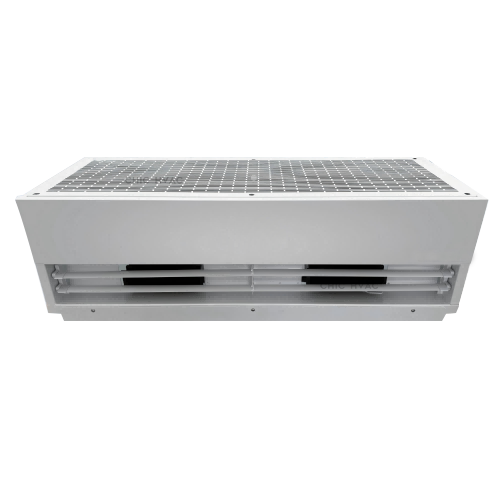
Barriera d'aria industriale. La velocità dell'aria e la portata d'aria pubblicate sono indicate all'unità; l'altezza di installazione e la larghezza della porta determinano se tale prestazione raggiunge il pavimento.
Quick Answer: installare la barriera d'aria il più vicino possibile alla larghezza della porta, montata all'altezza per cui il modello è progettato, e impostare la velocità dell'aria per raggiungere il pavimento. La gamma di modelli pubblicata qui copre porte da 600 mm a 2.000 mm e velocità dell'aria da 7,5 m/s (unità per ascensori) a 30 m/s (unità industriali). Troppo stretta lascia spazi ai lati; montarla troppo in alto lascia che il flusso d'aria si dissolva prima di raggiungere il pavimento.
Nota: i valori in questa guida provengono dai dati pubblicati delle barriere d'aria su questo sito e descrivono quelle famiglie. Confermare qualsiasi modello specifico con la sua scheda tecnica prima di ordinare.
Passo 1. Abbinare la larghezza dell'unità alla porta
La decisione di installazione più importante è la larghezza. Una barriera d'aria funziona proiettando un muro d'aria continuo attraverso l'intera apertura della porta. Se l'unità è più stretta della porta, le strisce scoperte ai bordi lasciano passare direttamente l'aria esterna, e l'installazione è sotto le aspettative non importa quanto potente sia l'unità.
Misurare l'effettiva apertura libera, non il telaio, e scegliere il modello pubblicato la cui larghezza corrisponde. L'elenco dei modelli è costruito attorno a larghezze standard delle porte — 600, 900, 1.000, 1.200, 1.500, 1.800 e 2.000 mm appaiono tutte nella gamma pubblicata. Se la porta cade tra due dimensioni, prendere quella più grande piuttosto che accettare spazi ai bordi.
Passo 2. Impostare correttamente l'altezza di montaggio
Altezza di montaggio e velocità dell'aria sono due facce della stessa decisione. La barriera d'aria deve proiettare il suo flusso dal punto di montaggio fino al pavimento, mantenendo al contempo una velocità sufficiente a resistere alla differenza di pressione attraverso la porta. Montala troppo in alto e il flusso perde momento prima di raggiungere il pavimento; montala troppo in basso e ostruisce l'apertura.
Il valore di velocità dell'aria pubblicato è indicato all'unità, quindi la domanda utile è sempre: questa velocità è sufficiente a questa altezza? Ecco perché un'unità con una velocità nominale inferiore a un'altezza di montaggio inferiore può superare le prestazioni di un'unità più veloce montata troppo in alto. In caso di dubbio, montare all'altezza per cui il modello è progettato anziché improvvisare.
Passaggio 3. Scegliere la velocità dell'aria per la porta
La velocità dell'aria non è un valore in cui “più è meglio”. Deve essere adattata alla pressione che la porta affronta e all'altezza che deve coprire, e una velocità troppo elevata semplicemente spreca energia e genera rumore. L'intervallo pubblicato su questo sito copre tre ampie fasce:
- Ascensori around 7.5 m/s, on compact units and doors with no significant external pressure.
- Cross-flow and commercial duties: around 9–13 m/s, the typical band for shop and office doorways.
- Industrial and high-exposure duties: 16–30 m/s, for large openings, wind exposure and temperature separation.
Match the band to the duty before choosing a model. A commercial doorway does not need a 30 m/s industrial unit, and an exposed loading bay will not be sealed by a 13 m/s unit.
Step 4. Check the supply and the mounting structure
Air curtain families differ widely in power draw, and the larger ones need three-phase supply. The published industrial range runs from 1,350 W to 3,400 W at 380 V; the compact cross-flow and elevator units run from 80 W to 350 W at 220 V. Confirm the supply before selecting, and confirm that the wall or ceiling above the door can carry the unit weight — the published figures run from about 5 kg on compact units to 78 kg on the largest industrial models.
Step 5. Decide heating or unheated
An air curtain can be unheated (air recirculation and door sealing only) or heated (electric, water or gas, adding a temperature lift to the air stream). Choose based on whether the doorway needs to hold temperature for comfort, or simply stop draughts and insects. The published heated range here uses PTC heating with multiple power settings, which is worth knowing if running cost matters over long periods.
Published air curtain data (reference)
The table below reproduces published values across the air curtain families on this site, to show the width, speed and power spread between them.
| Family | Modello | Supply | Alimentazione | Airflow (m³/h) | Air speed (m/s) | Rumorosità (dB) | Width / size (mm) |
|---|---|---|---|---|---|---|---|
| Elevator (compact) | FM-125-08DT | 220 V / 50 Hz | 80 W | 860 | 7.5 | ≤49 | 800 × 146 × 173 |
| Cross-flow (Q series) | FM-125-06 | 220 V / 50 Hz | 105 W | 1,200 | 9–11 | 50 | 600 × 145 × 185 |
| Cross-flow (Q series) | FM-125-12 | 220 V / 50 Hz | 160 W | 1,700 | 9–11 | 58 | 1,200 × 145 × 185 |
| Cross-flow (Q series) | FM-125-20 | 220 V / 50 Hz | 280 W | 2,900 | 9–11 | 61 | 2,000 × 145 × 185 |
| Cross-flow (B series) | LK-FM4015 | 220 V / 50 Hz | 260 W | 3,580 | 11–13 | 55 | 1,500 × 175 × 210 |
| Cross-flow (B series) | LK-FM4020 | 220 V / 50 Hz | 350 W | 4,280 | 11–13 | 56 | 2,000 × 175 × 210 |
| Centrifugal (X5 series) | LK-FM4509-L/Y | 220 V / 50 Hz | 230 W | 1,100 | 16 | 50 | 900 × 215 × 230 |
| Industrial | FM-6509 | 380 V / 50 Hz | 1,350 W | 4,510 | 30 | 70 | 900 × 352 × 306 |
| Industrial | FM-6515 | 380 V / 50 Hz | 2,700 W | 9,000 | 30 | 72 | 1,500 × 352 × 306 |
| Industrial | FM-6520 | 380 V / 50 Hz | 3,400 W | 11,200 | 30 | 71 | 2,000 × 352 × 306 |
| Heated (PTC, high power) | RM-1209D/Y | 380 / 220 V, 50 Hz | 6 / 4 / 2 kW PTC | 1,000 | 8.0–6.5 | 55 | 900 × 184 × 257 |
| Heated (PTC, high power) | RM-1215D/Y | 380 / 220 V, 50 Hz | 10 / 8 / 6 kW PTC | 1,400 | 8.0–6.5 | 58 | 1,500 × 184 × 257 |
Source: published air curtain data on this site, across the elevator, cross-flow (Q and B series), centrifugal (X5), industrial (FM-65 series) and heated (RM-12 series) families. Air speed is a published figure at the unit; the first dimension is the unit width (doorway it suits). The heated rows publish PTC power settings rather than a single figure, and are shown in that form. These values describe the families and are not a site-specific guarantee.
Reading the table: an example
Say you are sealing a 1,500 mm shop doorway with normal foot traffic and no heavy wind exposure. Run your eye down the width column. FM-125-15 (cross-flow Q series) covers a 1,500 mm doorway at 9–11 m/s on 200 W, quiet at 59 dB. LK-FM4015 (cross-flow B series) also covers 1,500 mm but at 11–13 m/s and 3,580 m³/h on 260 W, which gives a stronger air stream for a busier or more exposed doorway. Now take the same width on a loading bay that faces the weather: FM-6515 covers 1,500 mm at 30 m/s on 2,700 W and three-phase supply, which is the right band for that exposure but needs the electrical infrastructure. Which one is right depends on what the doorway actually faces, and that is a site judgement rather than a catalogue one.
Need this sized for your doorway?
Send us the clear door width and height, what the doorway faces (wind, traffic, temperature difference), whether you need heating, the supply available and the mounting structure. We shortlist the exact model before quotation.
Common installation mistakes
- Unit narrower than the door: leaves edge gaps and lets air straight through. Match the width, and round up rather than down.
- Mounted too high: il flusso d'aria si dissipa prima di raggiungere il pavimento, quindi il vano porta non è sigillato nemmeno alla massima velocità.
- Velocità dell'aria scelta per abitudine: un'unità commerciale non sigilla un vano esposto, e un'unità industriale sopra la porta di un negozio tranquillo spreca energia e produce rumore.
- Alimentazione verificata per ultima: i modelli industriali richiedono la trifase. Confermare l'alimentazione dopo aver scelto il modello può invalidare l'intera selezione.
- Peso ignorato: le unità industriali più grandi pesano circa 78 kg. La struttura di montaggio deve essere progettata per questo.
Frequently asked questions
A quale altezza va montata una cortina d'aria?
All'altezza per cui il modello è progettato. Montarla più in alto fa perdere slancio al flusso d'aria prima che raggiunga il pavimento. La velocità dell'aria dichiarata è riferita all'unità, quindi è l'altezza d'installazione a decidere se tale velocità sigilla ancora il vano porta.
Una cortina d'aria può essere più larga della porta?
Può esserlo, ed è preferibile arrotondare per eccesso anziché per difetto. Un'unità sovradimensionata può essere regolata verso il basso; una sottodimensionata non può coprire l'apertura per cui non è stata dimensionata.
Mi serve una cortina d'aria riscaldata?
Solo se il vano porta deve mantenere la temperatura per il comfort. Un'unità non riscaldata blocca comunque spifferi, polvere e insetti. I modelli riscaldati aggiungono un incremento di temperatura con un costo di esercizio, quindi la scelta dipende da ciò di cui lo spazio ha bisogno.
Are the table values final for ordering?
They are published reference values for the families. For ordering, the exact model nameplate data and your project condition govern. Each product page carries the full published snapshot.
Plan your installation with Linggongshare
Linggongshare supplies industrial, ceiling, cold-storage, cross-flow, centrifugal, elevator and heated air curtains, plus duct fans, HRV units, filters and heaters. To request a quote, send us the doorway dimensions, the exposure, whether you need heating, the supply and the destination market. Browse the full product selection hub or the air curtain hub, or contact us and we will help you narrow it down.
Published 16 September 2026. Reviewed against the published air curtain data across the elevator, cross-flow, centrifugal, industrial and heated families.
 English
  Русский
  Français
  Deutsch
  Italiano