
Industrial Dehumidifier Installation and Drainage Guide
Planifiez l'installation d'un déshumidificateur industriel avec les caractéristiques de la pièce, l'évacuation des condensats, l'accès de maintenance et les données électriques avant de demander l'étude d'un modèle.

Quick Answer
An industrial dehumidifier installation needs more than a litres-per-day figure. Before choosing a unit, confirm the room volume, target relative humidity, temperature range, moisture sources, electrical supply, condensate route and access for cleaning and service. For continuous operation, plan the drain before delivery: the outlet must lead to a suitable floor drain, collection point or approved pump arrangement, and the route must be checked for slope, height and maintenance access. Use the existing industrial dehumidifier capacity sizing guide to estimate the capacity range, then send the full site information with your quote request.
Installation Inputs to Confirm First
| Input | Pourquoi c'est important | What to provide |
|---|---|---|
| Room volume | Capacity depends on air volume, not floor area alone | Length, width and clear height |
| Current and target RH | The humidity gap changes the load | Seasonal high RH and target RH |
| Temperature | Product suitability and defrost behaviour depend on the operating environment | Typical and lowest operating temperature |
| Moisture sources | Open doors, fresh air and process moisture can dominate the load | Door frequency, ventilation and process description |
| Electrical supply | The selected model must match the available power | Voltage, phase, frequency and site protection |
| Drainage | Continuous operation needs a controlled condensate path | Drain location, height, route and pump requirement |
| Service access | Filters, coils and controls need inspection space | Access side, clearance constraints and lifting route |
Choose the Capacity Before the Installation Detail
The industrial vs household dehumidifier guide explains why industrial projects should start with the moisture load rather than a household room-size rule. The existing capacity guide lists the HT-DG series as 60, 90, 138, 168, 240, 360 and 480 L/D ranges. These are product-family reference points, not a substitute for a site calculation.
For a useful review, provide the room dimensions, target RH, temperature, air changes or fresh-air volume, people, open water or process sources, and the expected operating hours. If the project has an unusual low-temperature or high-moisture condition, identify it before a model is selected.
Drainage Options for Continuous Operation
Floor drain or nearby collection point
A direct drain is usually the simplest arrangement when the outlet and route are close to the unit. Confirm the drain location, route protection and whether the hose can maintain the required fall. Do not assume that a convenient-looking outlet is suitable without checking its height and access.
Collection tank
A tank can work for a temporary or supervised installation, but it adds a manual emptying task. It is a poor fit when the unit is expected to run unattended for long periods unless the tank size, alarm and inspection routine are defined.
Pumped drainage
If gravity drainage cannot reach the approved discharge point, the project may need a pump arrangement. The required pump capacity and lift must be confirmed against the selected unit and site route. This guide does not assign a universal pump head because it varies by product, hose route and building conditions.
High-level or remote drainage
A high-level route needs a confirmed pump, secure hose routing and an accessible inspection point. Keep the connection protected from kinks and accidental disconnection. The final solution should be reviewed with the product datasheet and the installer before delivery.
Plan the Location Around Airflow and Service
Place the unit where the return and supply air path is not blocked by stored goods, walls or temporary partitions. Keep the control side and filter access reachable. For a warehouse or production space, also confirm forklift traffic, condensation protection, floor loading and the route for bringing the unit into position.
Do not use a generic clearance number unless it appears in the selected model’s technical table. A site drawing with the unit footprint, door swing, drain route, power point and service side is more useful than a guessed universal dimension.
Installation Handover Checklist
- Room length, width and height recorded
- Current RH, target RH and temperature range recorded
- Moisture sources and door or fresh-air conditions described
- Selected capacity range linked to a product-family page
- Voltage, phase and frequency confirmed
- Drain point and route marked on the plan
- Gravity or pump arrangement identified
- Filter and service access checked
- Delivery route, lifting and final placement confirmed
- Responsibility for cleaning, tank checks and fault reporting assigned
FAQ
Can an industrial dehumidifier drain continuously?
It can be planned for continuous operation when the selected product and the site drainage arrangement are compatible. Confirm the outlet, route, slope or pump requirement and the maintenance responsibility before ordering.
Does a larger room always need a larger unit?
Not automatically. Room volume is important, but target RH, temperature, air changes, open doors and process moisture can change the required capacity significantly. Use the capacity guide as a starting point and submit the complete operating conditions for confirmation.
Can I use a household dehumidifier in a warehouse?
A household unit may not match the air volume, duty cycle, drainage arrangement or electrical requirements of an industrial space. Compare the application and service expectations in the industrial vs household guide before selecting a product.
What should I include in a quotation request?
Include room dimensions, target RH, temperature, moisture sources, power supply, operating hours, drain location, pump or gravity preference, quantity and destination. The industrial dehumidifier hub and dehumidifier series hub provide the starting product context.
Related Products and Next Step
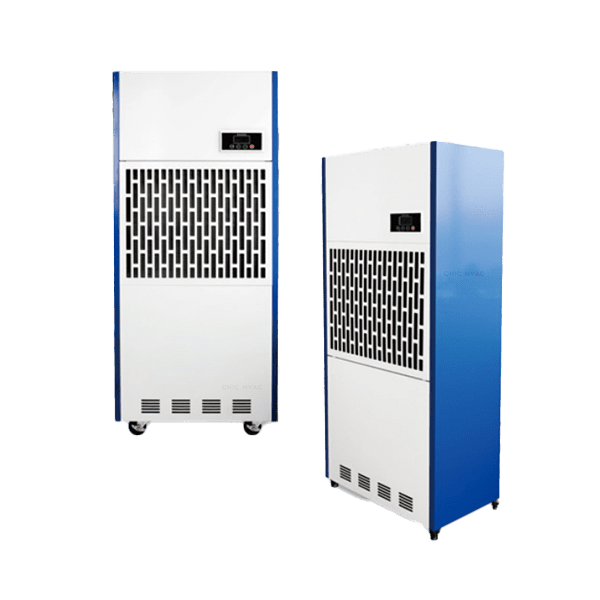
For a project using a higher-capacity configuration, review the HT-DG240A1 industrial dehumidifier as a product reference, then compare the available ranges in the industrial dehumidifier hub. Send the site inputs through the request a quote page so the final model and drainage arrangement can be checked against the actual conditions.
 English
  Русский
  Français
  Deutsch
  Italiano