
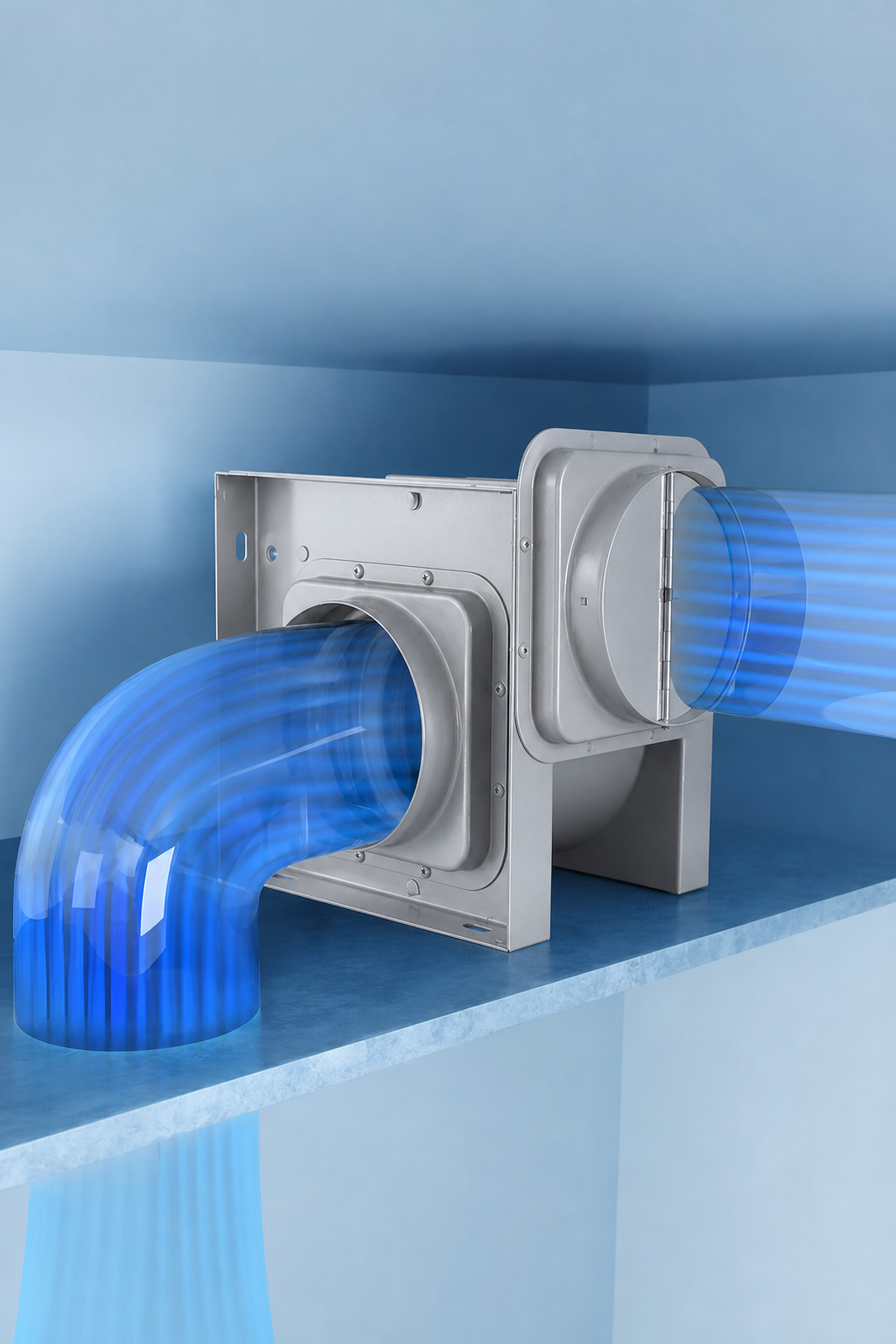
Inline Duct Fan vs Mixed-Flow Fan: Which Should You Choose?
Inline duct fan vs mixed-flow fan: how axial, mixed-flow and centrifugal in-duct fans differ, and how to choose by airflow, static pressure, duct run and noise.

Inline Duct Fan vs Mixed-Flow Fan: Which Should You Choose?
Both an inline duct fan and a mixed-flow fan sit inside the duct run and move air along it, but they are built differently. An axial inline fan, which is a propeller-style impeller inside a duct spigot, moves a high air volume at modest pressure. It suits short, straight runs with low resistance. A mixed-flow fan uses a diagonal impeller that adds pressure while keeping a compact in-duct shape, so it suits longer runs, extra bends and outlet resistance. A centrifugal in-duct fan produces the most pressure of the three and is chosen when the duct system is the most demanding.
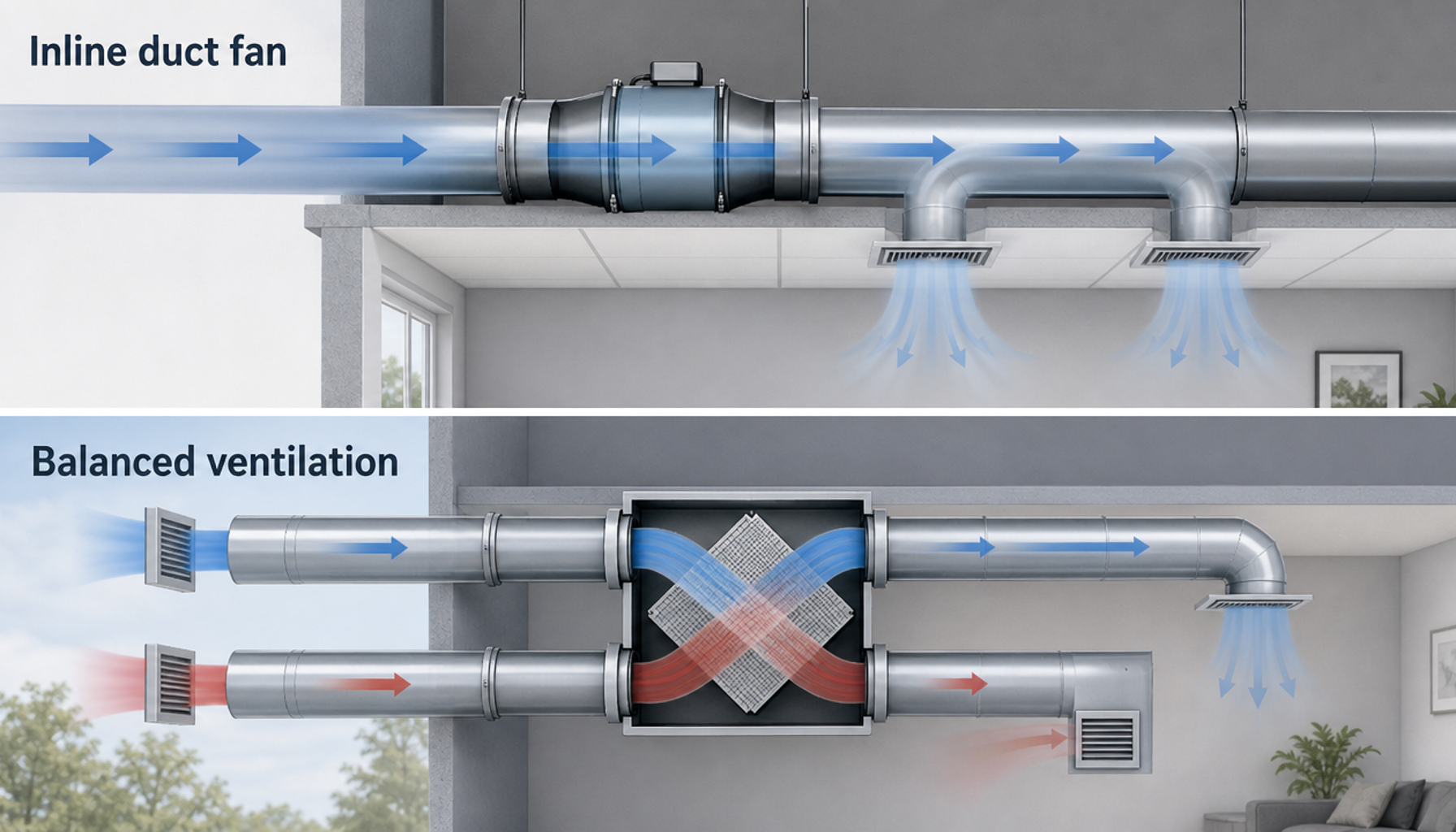
Concept illustration: how an inline duct fan boosts airflow along a duct run.
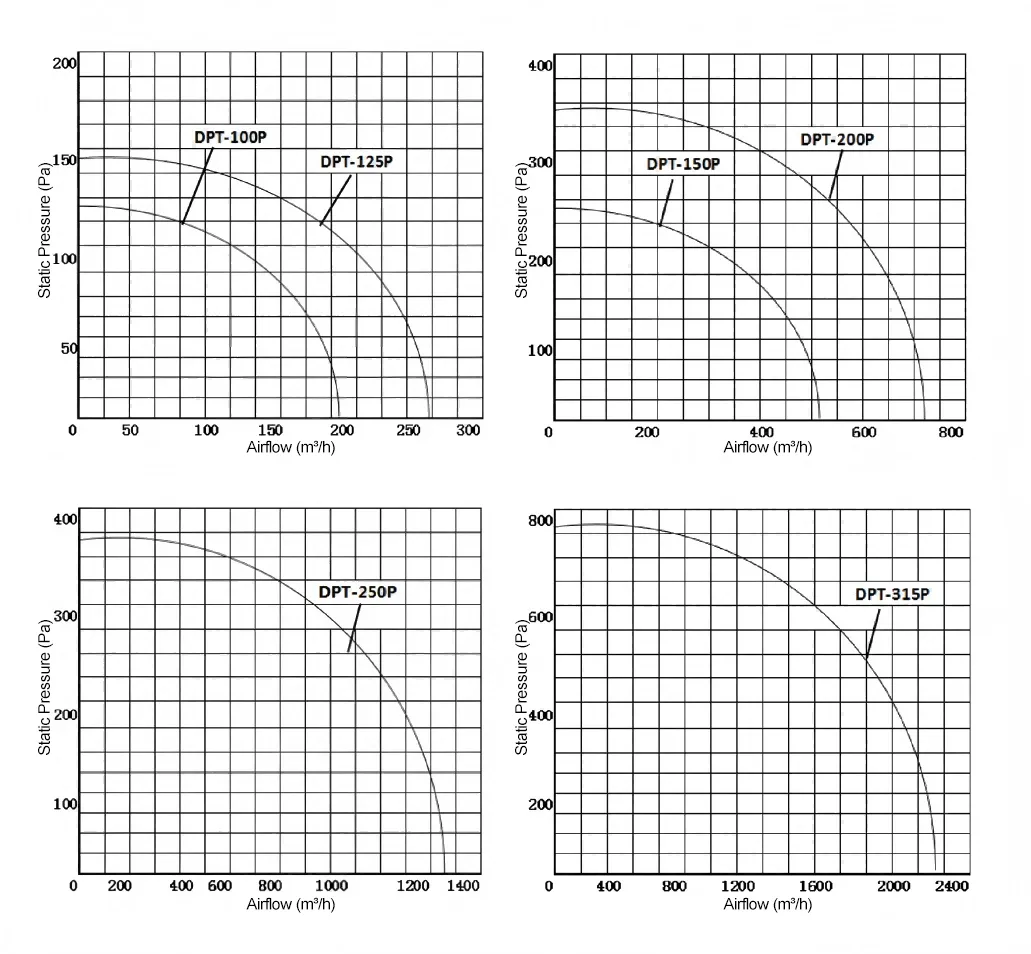
Airflow and static pressure are read together: as duct resistance rises, delivered airflow falls.
Quick Answer: Choose axial inline for short, straight runs where airflow matters most and resistance is low. Choose mixed-flow when the run is longer or has several bends and you still want quiet, compact in-duct installation. Choose centrifugal when the system resistance is high (long duct, many fittings, filters, or a heat exchanger). In every case, look at the published static pressure at the required airflow. Airflow on its own is not enough.
Note: values below are taken from the published duct-fan data on this site. They describe each family and are not a site-specific performance guarantee. Confirm the exact model against its datasheet before ordering.
How the three in-duct fan types differ
| Property | Axial inline | Mixed-flow | Centrifugal in-duct |
|---|---|---|---|
| Impeller | Propeller blades | Diagonal / mixed-flow | Centrifugal wheel |
| Airflow for a given size | Highest | Moderate to high | Moderate |
| Pressure capability | Lowest | Medium | Highest |
| Best duct run | Short and straight | Medium length, some bends | Long, fittings, filters, heat exchangers |
| Typical noise | Moderate | Quieter at low speed | Higher at pressure duty |
| Compactness in duct | Very compact | Compact | Bulkier |
| Typical duty | Bathroom, grow-room, short extract | Whole-house and light commercial duct | Gefilterte Zuluft, HRV/ERV-Boost, lange Leitungswege |
Die eine Regel, die am wichtigsten ist: Statischen Druck abstimmen, nicht nur den Luftvolumenstrom
Der häufigste Auswahlfehler ist, einen Ventilator nur nach seiner Luftstromzahl auszuwählen. Der Luftstrom wird bei einem bestimmten Druck angegeben; steigt der Kanalwiderstand, sinkt der tatsächlich gelieferte Luftstrom. Wenn der angegebene Luftstrom bei niedrigem Druck angegeben wird und das reale Kanalsystem lang ist oder mehrere Bögen hat, liefert der Ventilator zu wenig. Lesen Sie den Luftstrom immer zusammen mit dem statischen Druck am selben Betriebspunkt und fügen Sie einen Zuschlag für einen verschmutzten Filter oder einen zusätzlichen Bogen hinzu.
Veröffentlichte Referenzdaten
Mischstrom-Inline: DPT-P-Serie
Zweistufige und einstufige Mischstromgeräte. Die zweistufigen Modelle ermöglichen dem Installateur die Wahl zwischen hohem oder niedrigem Luftvolumen, um Geräusch und Betrieb auszubalancieren.
| Modell | Stufe | Leistung (W) | Luftstrom (m³/h) | Static pressure (Pa) | Geräusch (dB) | Kanal (mm) |
|---|---|---|---|---|---|---|
| DPT-100P | High / Low | 40 / 30 | 204 / 160 | 132 / 106 | 31 / 26 | 100 |
| DPT-150P | High / Low | 60 / 48 | 450 / 360 | 280 / 240 | 33 / 29 | 150 |
| DPT-200P | High / Low | 145 / 125 | 840 / 690 | 350 / 270 | 63 / 55 | 200 |
| DPT-250P | Single | 230 | 1400 | 489 | 66 | 250 |
| DPT-315P | Single | 360 | 2200 | 690 | 69 | 315 |
Silent mixed-flow inline: HF series
A compact quiet mixed-flow range for residential and light commercial duct, with a consistent 300 Pa static pressure across the sizes.
| Modell | Leistung (W) | Luftstrom (m³/h) | Static pressure (Pa) | Noise dB(A) | Speed (rpm) |
|---|---|---|---|---|---|
| HF-100/125 | 45 | 310 | 300 | 30 | 2550 |
| HF-150 | 75 | 540 | 300 | 45 | 2550 |
| HF-200 | 130 | 1200 | 300 | 55 | 2500 |
Centrifugal in-duct: DJT-B series
Metal round centrifugal in-duct fans. These deliver noticeably higher static pressure (up to 720 Pa) than axial or mixed-flow units from a similar duct size, which is why they are chosen for longer or more resistive systems.
| Modell | Stromversorgung | Luftstrom (m³/h) | Static pressure (Pa) | Geräusch (dB) | Kanal (mm) | Applicable area (m²) |
|---|---|---|---|---|---|---|
| DJT10-25B | 61 W | 300 | 377 | 62 | 100 | 12–16 |
| DJT12-35B | 62 W | 385 | 339 | 61 | 125 | 16–21 |
| DJT15-45B | 88 W | 700 | 399 | 66 | 150 | 29–38 |
| DJT20-46B | 168 W | 1165 | 594 | 70 | 200 | 48–64 |
| DJT25-66B | 185 W | 1255 | 596 | 70 | 250 | 52–69 |
| DJT31-66B | 223 W | 1740 | 720 | 76 | 315 | 72–96 |
Slim multi-room inline: DPT-H series
A slim in-duct unit often used where one unit serves a bathroom or utility room, with an application-area guide alongside the duty data.
| Modell | Stufe | Leistung (W) | Luftstrom (m³/h) | Static pressure (Pa) | Geräusch (dB) | Kanal (mm) | Application area (m²) |
|---|---|---|---|---|---|---|---|
| DPT10-24H | H / L | 48 / 38 | 230 / 180 | 160 | 25 | φ100 | 8–15 |
| DPT15-34H | H / L | 60 / 45 | 350 / 250 | 220 | 30 | φ150 | 20–25 |
| DPT20-56H | H / L | 104 / 80 | 920 / 700 | 365 | 38 | φ200 | 40–47 |
| DPT20-66H | H / L | 135 / 103 | 1200 / 1050 | 410 | 45 | φ200 | 40–60 |
Source: published duct-fan family data. Values are family ranges; the exact model datasheet governs ordering.
How to choose in four steps
- Estimate the required airflow from the room volume and target air changes, or from the extract point requirement.
- Estimate the system static pressure from duct length, bends, grilles and any filter or heat exchanger. This step decides the fan type: low pressure → axial/mixed-flow; high pressure → centrifugal.
- Pick the duct diameter that fits the run, then choose the smallest fan in that size that meets both the airflow and the pressure at the same operating point.
- Check noise and supply. For occupied spaces, prefer a dual-speed model run at low speed, and confirm 220 V / 50 Hz supply.
Benötigen Sie eine Dimensionierung für Ihr Projekt?
Send the required airflow, static pressure, supply and installation details. We shortlist the exact model and confirm the duty point before quotation.
When each type is the wrong choice
- Axial inline in a long, bendy run: it will lose airflow once resistance rises. Use mixed-flow or centrifugal instead.
- Mixed-flow where the system resistance is very high: a centrifugal unit is the safer choice.
- A single fan trying to cover a large duct system with filters: confirm the pressure at the duty point or the unit will under-deliver.
- Noise-sensitive bedroom next to a high-pressure fan: use a larger low-speed unit or an acoustic enclosure rather than a small fast fan.
Häufig gestellte Fragen
Is a mixed-flow fan better than an axial inline fan?
Neither is universally better. A mixed-flow fan produces more pressure for the same duct size, so it suits longer runs and more fittings. An axial inline fan moves more air at low pressure and suits short, straight runs. Choose by the duct system resistance, not by the type name.
Can I use a mixed-flow fan for a whole-house system?
Yes. Mixed-flow in-duct fans are commonly used for whole-house and light commercial duct ventilation because they balance airflow, pressure and noise. For long runs with filters or a heat exchanger, step up to a centrifugal in-duct fan.
Why is airflow different from what the catalogue says?
Because airflow is published at a specific static pressure. If the installed duct system has more resistance than the test condition, the delivered airflow is lower. Read airflow and pressure together, and allow a margin.
Kann Linggongshare das genaue Modell empfehlen?
We can shortlist models once the required airflow, duct length and fittings, duct diameter and acceptable noise are known. Final selection should be confirmed against the model datasheet.
Plan your duct ventilation with Linggongshare
Linggongshare supplies inline duct fans, mixed-flow fans, centrifugal fans, exhaust fans and air curtains for residential, commercial and industrial ventilation. To request a quote, send the required airflow, duct length and diameter, static pressure, supply voltage and destination market. Browse the inline duct fan selection hub or the full product selection hub, or contact us for project support.
Published: 11 September 2026. Reviewed for consistency against the published duct-fan family data.
 English
  Русский
  Français
  Deutsch
  Italiano