
ERV vs HRV: Which Ventilation System Fits Your Building?
An ERV and an HRV both bring outdoor air in while exhausting stale indoor air. The practical difference is what each recovery core transfers: an HRV focuses on

ERV vs HRV: Which Ventilation System Fits Your Building?
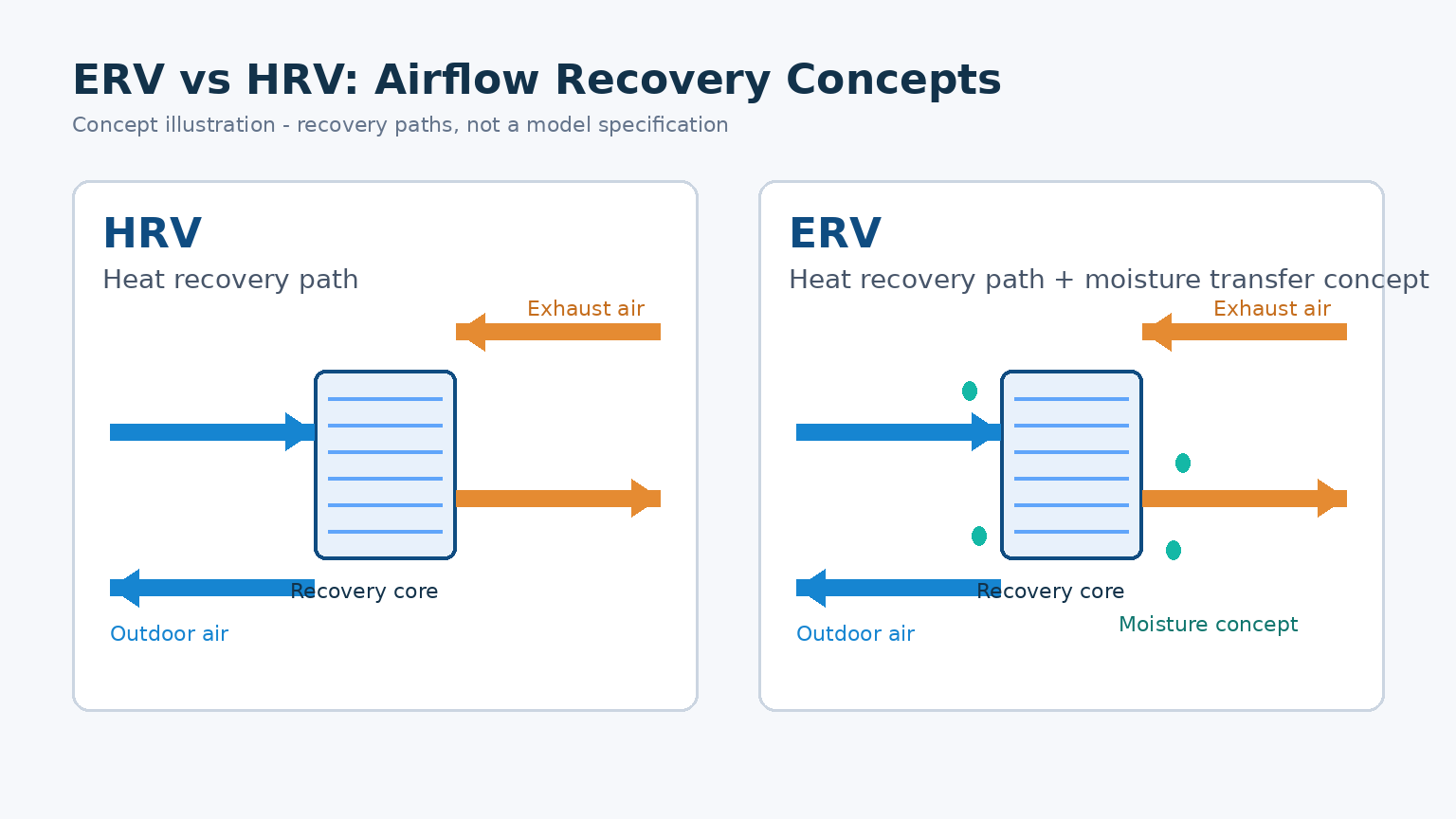
An ERV system and an HRV both bring outdoor air in while exhausting stale indoor air. (The pair is searched under several names — HRV ERV, ERV vs HRV, energy recovery ventilation — but the comparison is the same.) The practical difference is what each recovery core transfers: an HRV focuses on heat, while an ERV transfers heat and a portion of moisture. The right starting point is the building’s climate, moisture conditions, occupancy pattern, and duct layout, not a generic product label.
Quick Answer: Choose the system category after defining whether humidity transfer matters for the building. An HRV is a heat-recovery ventilation approach. An ERV is an energy-recovery ventilation approach that also considers moisture transfer. Exact equipment selection still depends on the published model data, local design requirements, duct routing, electrical supply, and the project’s indoor-air objectives.
What both systems do
Both systems use separate supply and exhaust air paths. Outdoor air enters the building while stale indoor air leaves it. A recovery core lets energy move between those paths without simply mixing the two airstreams.
For a buyer, this creates a clearer question than “Which unit is better?” Start by defining the building use, occupancy, outdoor conditions, indoor moisture concern, and available installation route. Those inputs determine which product family deserves closer review.
The difference between HRV and ERV
An HRV is commonly used to describe ventilation equipment that recovers sensible heat between outgoing and incoming airstreams. In simple terms, it helps retain temperature energy that would otherwise be exhausted.
An ERV system is commonly used to describe ventilation equipment that transfers both heat and some moisture energy. This makes moisture conditions part of the selection discussion, alongside airflow, duct resistance, and installation space.
The distinction is conceptual. It is not a substitute for an exact model datasheet. Do not assume that a family label proves a specific airflow value, recovery efficiency, electrical configuration, or document scope.
Start with the building, not the equipment name
Use these questions to frame the selection conversation:
- Is the project a single room, a residence, or a larger commercial area?
- Does the building team need to consider indoor humidity as well as temperature?
- What outdoor conditions affect the project during normal operation?
- Where can supply and exhaust ducts run?
- What airflow target, electrical supply, and installation limits must the final model meet?
This sequence helps avoid selecting a ventilation category before the site conditions are clear.
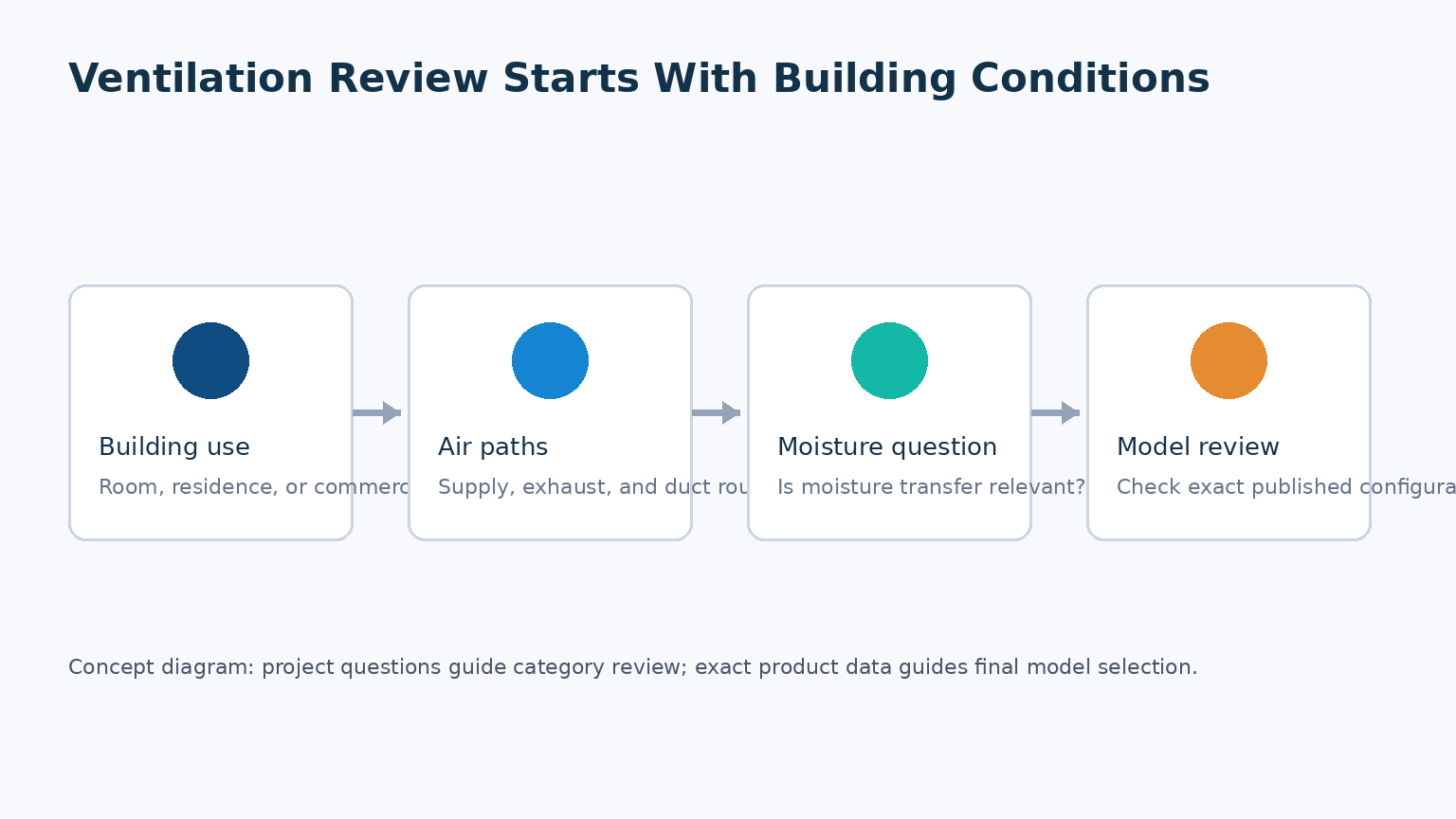
Concept illustration: building questions guide category review. Exact product data remains the final model-selection source.
When to review a single-room HRV route
A single-room route is relevant when ventilation is planned room by room rather than through one larger central system. The page for each product is the correct place to verify the available configuration and its published details.
Review the Single-Room HRV Selection Hub to compare the currently published room-level product paths. For a model-level example, review the VT501-WiFi Single Room HRV product page and confirm the control version, wall thickness, airflow setting and power supply against the project before quotation. For a model review, send the room use, installation location, required airflow, wall or duct constraints, electrical supply, and destination market.
Published single-room HRV examples
The Linggongshare product database records distinct single-room HRV model paths. These are examples for identity and published configuration review, not a substitute for a project calculation.
| Model path | Published airflow settings | Published supply field | Source boundary |
|---|---|---|---|
| VT100 / VT100-WF | 20, 30, 40, 50 m³/h | 100-240 V | KCVENTS Single Room HRV product record |
| VT125 / VT125-WF | 20, 30, 45, 60 m³/h | 12 VDC / 100-240 V | KCVENTS Single Room HRV product record |
| VT501 family | 20, 48, 54, 60 m³/h | 12 VDC / 100-240 V | KCVENTS Single Room HRV product record |
Use the exact product page and project conditions to confirm the applicable configuration. Do not transfer these values to an ERV family or to a differently named variant without model-level evidence.
When to review an ERV route
An ERV route is relevant when the project needs to assess heat and moisture transfer as part of a broader ventilation plan. The final choice should be confirmed against the exact product page and project conditions rather than inferred from the term “ERV.”
Review the Energy Recovery Ventilator Selection Hub for commercial, residential, and inline product paths. Send the application, target airflow, installation type, duct route, electrical supply, humidity concern, quantity, and destination market to request a focused review.
A simple decision path
- Define the building area and the ventilation objective.
- Identify whether humidity transfer needs to be part of the discussion.
- Review the applicable HRV or ERV product route.
- Check the exact model’s published information before specifying it.
- Send the project inputs needed for model confirmation.
What to confirm before requesting a quote
A useful inquiry includes the building application, target airflow, installation type, duct route, available electrical supply, indoor moisture concern, quantity, and destination market. This gives the review team the information needed to route the request to an appropriate published product family and then assess the exact model.
Request an ERV or HRV project review
FAQ
What is the main difference between an ERV and an HRV?
An HRV is generally discussed as a heat-recovery ventilation approach, while an ERV includes heat and moisture transfer in the selection discussion. That distinction helps frame the project, but it does not establish the performance of a specific model. Review the exact product information before making a specification decision.
Is an ERV always better than an HRV?
No. The correct route depends on the building’s climate, indoor moisture concerns, ventilation objective, duct arrangement, and the available product configuration. Treat ERV and HRV as two categories for the initial conversation. The exact model still needs to be matched to the project’s stated requirements.
Can a single room use heat-recovery ventilation?
A single-room ventilation route can be relevant when the project is planned room by room. Start with the room use, installation location, airflow need, and practical wall or duct constraints. Then review the published single-room product paths and request a model-specific review using the actual project inputs.
What details should I send for an ERV or HRV review?
Send the application, target airflow, installation type, duct route, available electrical supply, humidity concern, quantity, and destination market. These inputs help establish the correct product route and identify which exact model information must be checked before a quotation or project submission.
Plain summary
ERV and HRV systems both replace stale indoor air with outdoor air while recovering energy from exhaust air. The key difference is moisture transfer. Start with the building conditions and project inputs, then review an exact product route before choosing a model.
 English
  Русский
  Français
  Deutsch
  Italiano