
Sélection VRC mono-pièce : VT100 vs VT125 vs VT501-WiFi
How to choose between the VT100, VT125 and VT501-WiFi single-room HRVs: airflow, wall depth, supply and control, with published reference data.

Sélection VRC mono-pièce : VT100 vs VT125 vs VT501-WiFi
Choosing a single-room heat recovery ventilator comes down to five checks: the airflow the room needs, the wall or tube depth you actually have, the supply voltage on site, the control and filtration you want, and how quiet it has to be. Get those five right and the model usually picks itself. On this site there are three published single-room HRV models, and they differ mainly in peak airflow, supply options and control.
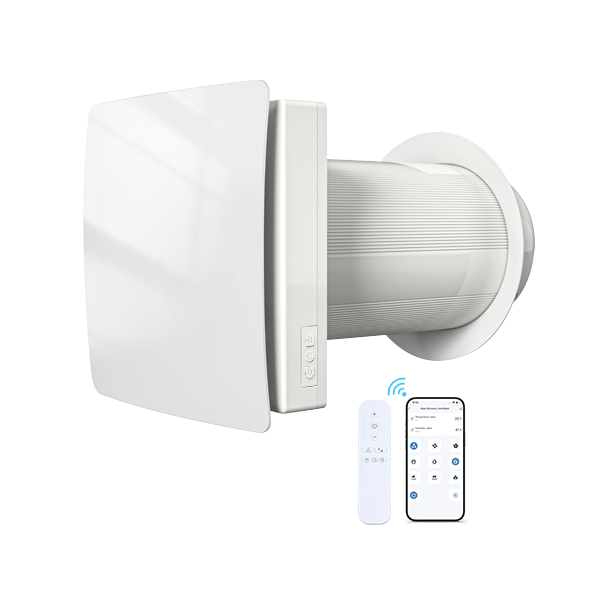
VT501-WiFi single-room HRV. The VT100, VT125 and VT501-WiFi are all through-wall ceramic-core units; they differ in peak airflow, voltage version and control.
Quick Answer: match the airflow to the room first, then confirm the wall or tube depth, then pick the supply version and control. The VT100 tops out at 50 m³/h, the VT125 and VT501-WiFi both reach 60 m³/h. Only the VT501-WiFi adds wall/tube depth 250–500 mm, a documented current row, and the WiFi/remote control option. The exact version still has to be confirmed against the datasheet before ordering.
Note: every value below is reproduced from the published product data on this site and describes that family. Confirm the exact model and version against its own datasheet before you order.
What a single-room HRV does
A single-room heat recovery ventilator (HRV) pairs a supply path and an exhaust path through one wall sleeve, with a ceramic core between them. As the two air streams cross, the core transfers heat from the outgoing stale air to the incoming fresh air, so you get ventilation without throwing away all the indoor heat. The core alternates direction on a cycle, which is why these units are sometimes called alternating or reversible single-room ventilators.
That design has one clear consequence: it is a room-by-room solution, not a whole-building one. One unit serves one room. If the project needs balanced ventilation across a whole dwelling or floor, that is a central ERV duty rather than a single-room HRV duty.
How to choose in five checks
Check 1. Airflow the room needs
Work out the required air volume first. If the design is expressed as air changes per hour, the required airflow is room volume multiplied by the target ACH. As a worked example: a 30 m³ bedroom at about 1 ACH needs roughly 30 m³/h, which the VT100’s speed II (40 m³/h) covers with margin. For a larger room or a higher ACH target, move up the airflow range or up a model. Write the figure down as a range if the design is not final, and size on the upper end.
Check 2. Wall or tube depth
The unit has to pass through the wall, so the wall thickness and sleeve depth constrain the choice. The VT501-WiFi publishes an installation tube / wall thickness of 250–500 mm. If your wall is outside the range a model publishes, that model is out regardless of its airflow. Measure the actual wall, not the nominal drawing.
Check 3. Supply voltage on site
All three models offer a 100–240 V 50–60 Hz version. The VT125 and VT501-WiFi also publish a 12 V DC version. Where the unit is fed from a low-voltage supply or a controller, that version matters; where it is fed from mains, the 100–240 V version applies. Confirm frequency (50 or 60 Hz) and the local supply before ordering — this is the most common pre-order mismatch.
Check 4. Control and filtration
The VT501-WiFi is the one with the WiFi / remote control option, and its published feature set includes a HEPA plus activated carbon filter stage. If the project needs app control, scheduled operation or a filtered supply, that narrows the field quickly. If a simple wall control is enough, the VT100 or VT125 is the simpler buy.
Check 5. Noise and speed stages
All three publish multiple speed stages from a sleep mode up to a high mode, and higher speed means more noise. In a bedroom, the sleep and low stages are what you will live with, so check that the low-speed airflow still meets the room’s minimum requirement rather than only looking at the peak figure.
Published VT100 / VT125 / VT501-WiFi data (reference)
The table below reproduces the published values for the three single-room HRV models so you can identify a first-pass candidate. The speed columns run from sleep mode to the highest stage.
| Spec item | VT100 | VT125 | VT501-WiFi |
|---|---|---|---|
| Voltage | 100–240 V 50–60 Hz | 12 V DC or 100–240 V 50–60 Hz | 12 V DC or 100–240 V 50–60 Hz |
| Airflow (m³/h), sleep → high | 20 / 30 / 40 / 50 | 20 / 30 / 45 / 60 | 20 / 48 / 54 / 60 |
| Total power (W) by speed | 2.5 / 3.0 / 3.5 / 3.8 | 2.5 / 6.0 / 8.5 / 12 | 2.5 / 3.0 / 4.5 / 8.5 |
| Current (A) by speed | — | — | 0.025 / 0.030 / 0.045 / 0.070 |
| Speed (RPM) by stage | 1000 / 1500 / 2000 / 2500 | 630 / 1200 / 2050 / 2900 | 630 / 1100 / 1600 / 2200 |
| Heat exchange efficiency | up to 90% | up to 90% | up to 90% |
| Heat exchanger core | Ceramic | Ceramic | Ceramic |
| Transported air temperature | −20 °C to +50 °C | −20 °C to +50 °C | −20 °C to +50 °C |
| Installation tube / wall | — | — | 250–500 mm |
| Control / filtration feature | Multi-speed | Multi-speed | WiFi / remote, HEPA + carbon |
Source: published product data for the VT100, VT125 and VT501-WiFi. Airflow and power are shown per speed stage; the heat exchange efficiency is a published “up to” figure for a ceramic core. These values describe the family and are not a site-specific guarantee.
Lecture du tableau : un exemple
Say a 45 m³ room needs about 1.5 ACH, so roughly 68 m³/h. Run your eye down the airflow row: the VT100 peaks at 50 m³/h and the VT125 and VT501-WiFi both reach 60 m³/h, so none of the three single units clears 68 m³/h on its own. That is the signal to either accept a lower ACH for the room, use two units, or move to a central solution. Now take the same room at 1 ACH (45 m³/h): the VT125 clears it at its third stage (45 m³/h) and the VT501-WiFi clears it at its second (48 m³/h), the latter with more headroom for filter loading and app control. Which one is right depends on whether you value the lower speed stage or the control features more.
Need this sized for your project?
Send us the room volume or target ACH, the wall thickness, the supply voltage and the control you want. We shortlist the exact version and confirm the duty point before quotation.
When a single-room HRV is not the right answer
- Whole-building ventilation: one unit serves one room. For balanced ventilation across a dwelling or floor, confirm a central ERV or a multi-room design. The ERV vs HRV guide covers how the two recovery cores differ.
- Very high airflow per room: if a single room needs well above 60 m³/h, a through-wall single-room unit is the wrong shape of product; look at ducted inline fans or a central unit.
- Heavy dust or grease in the extract path: kitchen grease and workshop dust need filtration and material confirmation that is outside the published single-room HRV envelope.
- Extreme supply conditions: the published transported-air range is −20 °C to +50 °C. Outside that, the application has to be reviewed.
Frequently asked questions
Is a single-room HRV the same as a central ERV?
No. A single-room HRV serves one room through a wall sleeve. A central ERV distributes balanced supply and extract across multiple rooms through ductwork. They solve different scopes.
How much airflow does a bedroom need?
Multiply the room volume by the target air change rate. A 30 m³ room at 1 ACH needs about 30 m³/h. Use the design figure if one exists and size on the upper end of the range if it does not.
Do I need the 12 V DC version or the mains version?
It depends on how the unit is fed. If it is supplied from mains, the 100–240 V 50–60 Hz version applies. If it is fed from a low-voltage supply or controller, the 12 V DC version applies. Confirm the local supply before ordering.
Les valeurs du tableau sont-elles définitives pour la commande ?
They are published reference values for the family. For ordering, the exact model and version nameplate data and your project condition govern. Each product page carries the full published snapshot.
Planifiez votre projet de ventilation avec Linggongshare
Linggongshare supplies HRV and ERV units, duct fans, exhaust fans, air curtains, dehumidifiers and heaters for residential, commercial and industrial ventilation. To request a quote, send us the room volume or target airflow, wall thickness, supply voltage and destination market. Browse the hub complet de sélection des produits ou le single-room HRV hub, ou contactez-nous et nous vous aiderons à affiner votre choix.
Published 16 September 2026. Reviewed against the published VT100, VT125 and VT501-WiFi data.
 English
  Русский
  Français
  Deutsch
  Italiano