
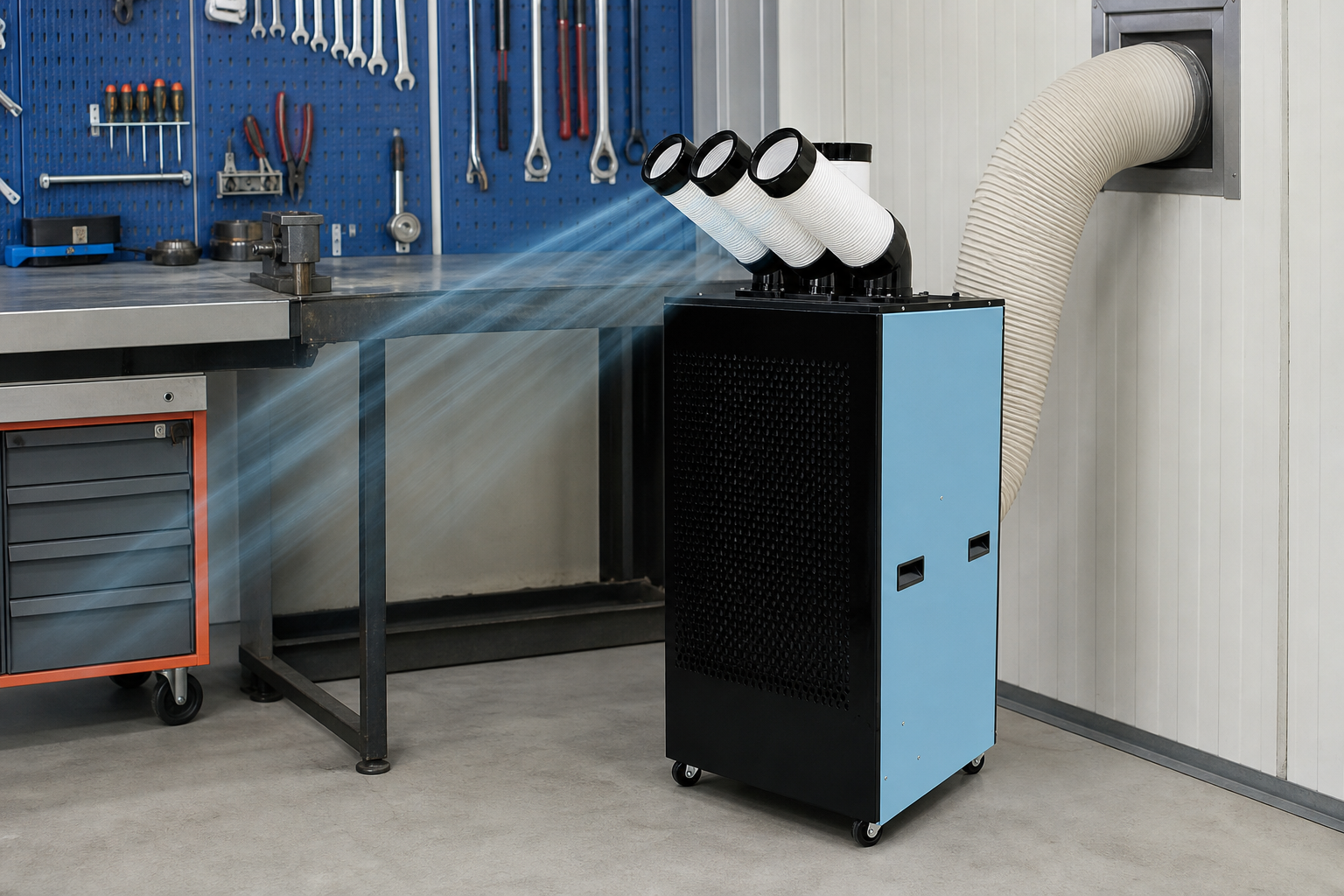
Portable vs Fixed Industrial Air Conditioner: Which Fits the Project?
Portable vs fixed industrial air conditioner: how to choose spot cooling or a fixed system by cooling target, exhaust route, load, power supply and noise, with published HT-P series data.

Portable vs Fixed Industrial Air Conditioner: Which One Fits the Project?
A portable industrial air conditioner is a self-contained spot-cooling unit on castors, with a duct to carry away the hot air. A fixed split or ducted air conditioner is installed permanently and distributes conditioned air through the room. The question that decides between them is not which one cools better. It is who or what has to be cooled. A portable unit cools a workstation, a person or a machine. A fixed system cools a whole room or building. Once that is clear, capacity, exhaust route, power supply and noise settle the exact model.
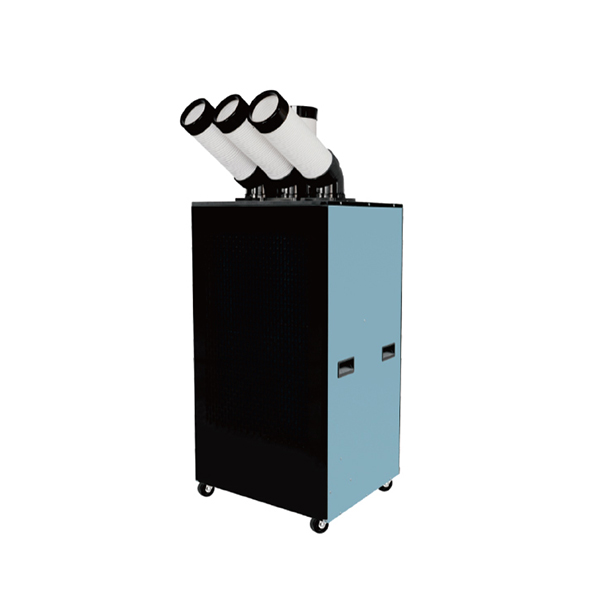
Portable industrial air conditioner (spot cooling). Hot exhaust air must be ducted outside.
Quick Answer: go portable when the heat source is local, the room cannot be closed, the need is temporary or seasonal, or a fixed installation is not possible. Go fixed when the whole space has to be held at a temperature, when the load is continuous and large, or when the room is sealed. A portable unit also needs a route for its hot exhaust air. Without one, its cooling effect drops sharply.
Note: the values below come from the published portable air conditioner data on this site and describe each model. They are not a site-specific performance guarantee. Confirm the exact model against its datasheet before ordering.
How a portable industrial air conditioner works
A portable unit pulls in room air, cools it over a refrigerant evaporator, and blows the cooled air toward the target. The heat it removes, plus the compressor’s own heat, is rejected through a second airstream that has to go outside, into a window, a wall vent or an existing exhaust path. This is the single most important installation constraint. A portable unit that cannot discharge its hot air will simply recirculate heat and lose most of its useful cooling.
A fixed system separates the evaporator indoors from the condenser outdoors, so it does not use indoor air for heat rejection and can hold a whole space at a set point. It needs professional installation, pipework and a permanent power supply, but it handles the continuous, room-wide loads that portable units cannot.
Side-by-side comparison
| Factor | Portable industrial AC | Fixed (split / ducted) AC |
|---|---|---|
| Cooling target | A person, workstation or machine | A whole room or building |
| Installation | Plug in and route the exhaust duct | Permanent, with pipework and outdoor unit |
| Mobility | Moves with the job, ideal for changing or temporary needs | Fixed location |
| Whole-room control | Not designed for it | Yes, holds a set point |
| Exhaust requirement | Essential: hot air must go outside | Heat rejected at the outdoor unit |
| Typical capacity | About 1.5 kW to 15 kW (5,000–51,000 BTU) | Scalable to the building load |
| Power supply | 220 V single-phase up to about 5 kW, 380 V for the largest | Usually 380 V three-phase |
| Noise at the unit | 52–73 dB(A), rising with capacity | Compressor usually remote, so quiet indoors |
| Best for | Hot spots, temporary work, rooms that cannot be closed, seasonal peaks | Continuous comfort or process cooling of a defined space |
| Main trade-off | Local cooling, needs exhaust, noise at the unit | Higher install cost and not portable |
Published portable AC data (reference)
The HT-P series runs from 5,000 to 51,000 BTU. Note that the largest model, the HT-P50GA, moves to a 380 V three-phase supply, and that maximum current is given so you can plan the circuit and breaker.
| Модель | Class | Cooling capacity | Rated power | Max current | Airflow | Noise | Refrigerant | Weight | Supply |
|---|---|---|---|---|---|---|---|---|---|
| HT-P20GA | <1 HP | 1,460 W (5,000 BTU) | 620 W | 3.9 A | 300 m³/h | 52 dB(A) | R134A | 26 kg | 220 V |
| HT-P909AG | 1 HP | 2,600 W (9,000 BTU) | 1,100 W | 6 A | 420 m³/h | 54 dB(A) | R410A | 53 kg | 220 V |
| HT-P20AG | 2 HP | 5,000 W (17,000 BTU) | 2,100 W | 11 A | 800 m³/h | 62 dB(A) | R410A | 60 kg | 220 V |
| HT-P30AG | 3 HP | 6,800 W (23,000 BTU) | 3,000 W | 15 A | 1,200 m³/h | 64 dB(A) | R410A | 70 kg | 220 V |
| HT-P50GA | 5 HP | 15,000 W (51,000 BTU) | 5,500 W | 14 A | 2,800 m³/h | 73 dB(A) | R410A | 185 kg | 380 V |
Source: published HT-P series data. Working temperature range 16–45 °C (checked per model), and drainage is automatic on these units.
How to choose: a short decision path
- What has to be cooled? A person or machine points to portable spot cooling. A whole room or building points to a fixed system.
- Can the hot exhaust air go outside? If not, a portable unit is the wrong tool until an exhaust route is planned.
- Is the need temporary, seasonal or moving? If yes, go portable. If it is continuous and fixed, go fixed.
- What is the load? Estimate the sensible heat to be removed, then match a capacity class with some margin. For a seated worker in a hot workshop, a 1 to 2 HP class is often enough. For large machinery or a big work zone, you are looking at 3 to 5 HP or several units.
- What supply do you have? Check 220 V single-phase against 380 V three-phase. The 5 HP model needs 380 V, so plan the circuit and breaker from the maximum current.
- How much noise is acceptable? At the unit, noise rises with capacity, from 52 dB(A) to 73 dB(A). If operators work right beside it, a smaller unit placed further away, or ducting the cold air to the spot, is usually the better arrangement.
When a portable AC is the wrong choice
- You expect whole-room cooling. Portable spot coolers are not a substitute for central or fixed HVAC, and the room load will exceed what a portable unit can hold.
- There is no exhaust path. Without a way to duct the hot air away, performance collapses and the room can get hotter rather than cooler.
- The load is continuous and large. For a permanent, room-wide duty, a fixed system is more efficient and quieter indoors.
- Outdoor or rain-exposed use. Standard portable units are not weather-rated, so check the IP rating and protection before such use.
Frequently asked questions
Can a portable industrial air conditioner cool a whole workshop?
No, not reliably. Portable units are designed for spot cooling, meaning a workstation, a person or a machine. For whole-room or whole-building cooling, a fixed system sized to the room load is the correct and more efficient choice.
Do portable industrial air conditioners need to be vented?
Yes. The unit rejects the removed heat plus compressor heat through a hot-air exhaust, which has to be ducted outside or into an existing exhaust path. Without a venting route, hot air recirculates and cooling performance drops sharply.
What power supply do they need?
Smaller models run on 220 V single-phase. The largest model, the HT-P50GA at 51,000 BTU, requires 380 V three-phase. Always plan the circuit and breaker using the published maximum current, not the rated current.
Can Linggongshare recommend the exact model?
Yes. Once we know the heat load, cooling target, exhaust route, supply voltage and acceptable noise, we can shortlist models. Final selection should be confirmed against the model datasheet and your site conditions.
Plan your spot-cooling project with Linggongshare
Linggongshare supplies portable air conditioners, air curtains, dehumidifiers, duct fans and heaters for industrial and commercial use. To request a quote, send us the heat source, cooling target, available exhaust route, supply voltage and destination market. Browse the industrial portable air conditioner hub or the full product selection hub, or contact us and we will help you narrow it down.
Published 11 September 2026. Reviewed against the published HT-P series data.
 English
  Русский
  Français
  Deutsch
  Italiano