
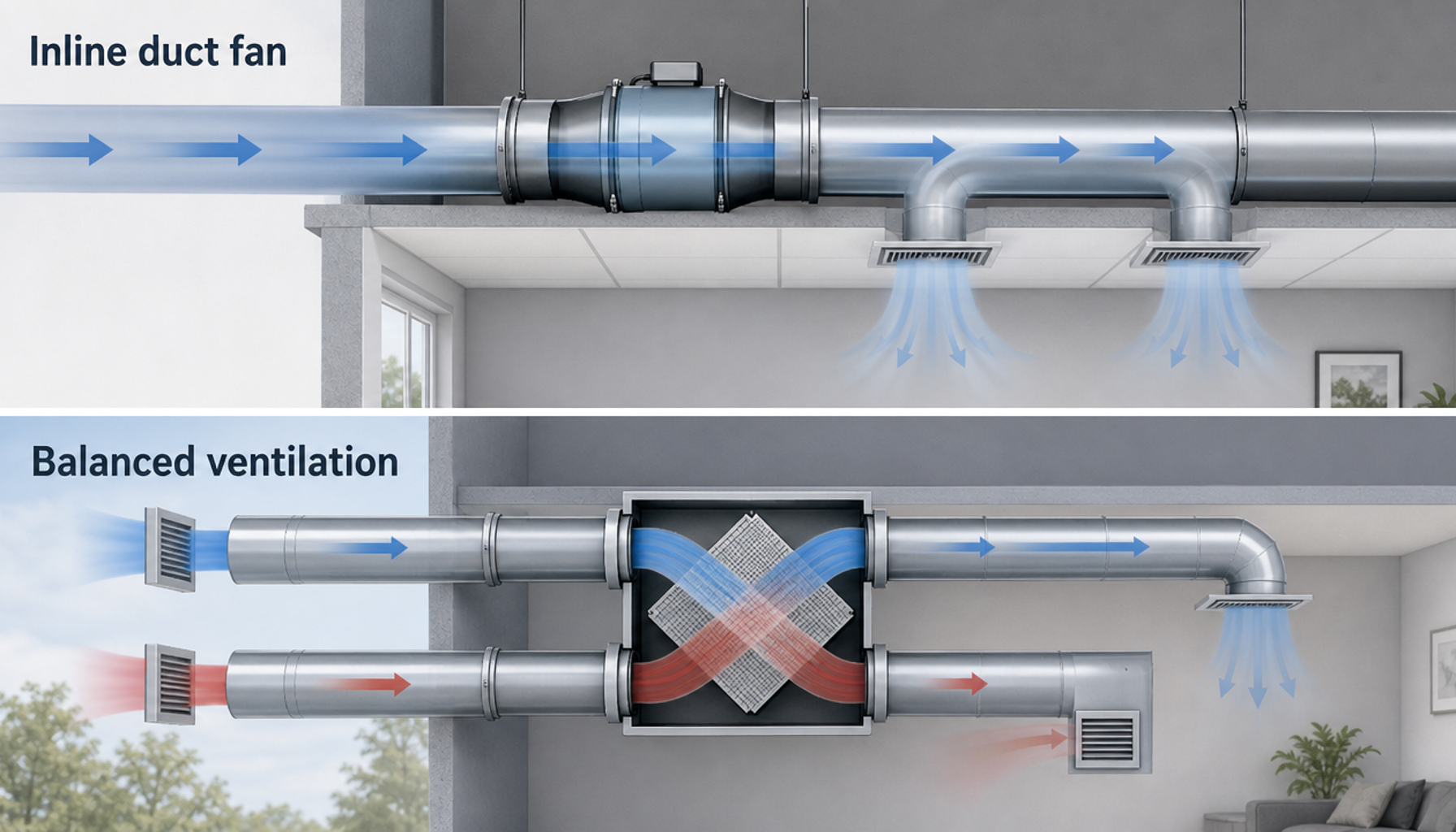
Inline Duct Fan: When It Helps, and When HRV or ERV Is Better
Poor airflow can be caused by duct resistance, an undersized route, dirty filters, closed dampers, or an unsuitable fan selection. Confirm the duct route, targe

Quick Answer: An inline duct fan is a booster installed in ductwork to help move air through a restrictive run. It can help where duct length, bends, filters, or grilles create resistance, but it does not recover heat or provide balanced outdoor-air ventilation like an HRV or ERV.
Poor airflow can be caused by duct resistance, an undersized route, dirty filters, closed dampers, or an unsuitable fan selection. Confirm the duct route, target airflow, static pressure, voltage, and noise requirement before selecting equipment.
Choose an inline duct fan, HRV, or ERV
| If your primary need is… | Start with… | Check before selecting |
|---|---|---|
| More airflow through an existing supply or exhaust duct | An inline duct fan | Duct diameter, route length, bends, target airflow, static pressure, power supply, and noise limit |
| Controlled outdoor-air supply and stale-air exhaust | An HRV or ERV | Whole-system design, climate, humidity load, room layout, and local ventilation requirements |
| Moisture control in a wet room | A correctly designed exhaust system | Moisture rating, discharge route, backdraft control, condensation risk, and applicable code |
An inline fan is not a substitute for a balanced ventilation design when a space needs planned outdoor-air supply and exhaust. An HRV transfers heat between outgoing and incoming air; an ERV transfers heat and moisture. Product selection should follow the project ventilation design and applicable local requirements.
Why use an inline duct fan?
Quick Answer: Use an inline duct fan when the existing duct route creates enough resistance that the installed fan no longer delivers the required airflow. It is an airflow-boosting solution, not a source of balanced fresh air.
CFM means cubic feet per minute, a standard airflow measure. ACH means air changes per hour. Required airflow depends on the room, occupancy, duct system, and applicable local requirements. Related terms include duct booster fan, in-line exhaust fan, and ventilation booster.
For product routes designed for duct resistance, see the inline duct fan selection hub and the mixed-flow inline fan range.
When is HRV or ERV a better fit?
Quick Answer: Choose a Heat Recovery Ventilator (HRV) or Energy Recovery Ventilator (ERV) when the project needs controlled outdoor-air exchange rather than only more airflow in an existing duct path.
If stale air affects a tight or continuously occupied space, a booster fan alone may not address the underlying ventilation design. The single-room HRV selection hub covers the project questions to confirm before choosing a room-based heat-recovery solution.
What specs matter most?
Quick Answer: Confirm duct diameter, rated airflow at the relevant pressure, sound data, electrical supply, and installation route. A free-air rating is not the same as delivered airflow after elbows, dampers, filters, and grilles are installed.
Match the fan to the existing duct and evaluate the full duct route. When humidity or fresh-air balance is the primary concern, use a system designed for that purpose rather than assuming an inline booster will solve it.
Need this sized for your project?
Send the application, required airflow and installation details. We confirm the product family and shortlist the model before quotation.
Запросить коммерческое предложениеSee the inline duct fan range →
FAQ
Q: Can an inline duct fan replace a bathroom exhaust fan?
A: Only when the completed system is designed and verified to meet the room’s ventilation requirements. Confirm moisture suitability, duct routing, discharge arrangement, condensation control, backdraft risk, and applicable local requirements before using one in a wet room.
Q: Does an inline duct fan bring in fresh air?
A: Not by itself. It moves air within or out of a ducted path. For planned outdoor-air supply and exhaust, use an HRV, ERV, or another ventilation system designed for balanced air exchange.
Q: What duct size works best?
A: Match the fan connection and performance data to the installed duct and its resistance. Duct size, route length, bends, filters, grilles, and pressure requirement all affect delivered airflow and sound.
Summary
An inline duct fan is a practical airflow booster for long or restrictive duct runs when the installed system does not deliver its required airflow. For planned outdoor-air exchange and heat or moisture recovery, use an appropriately designed HRV or ERV system; review the single-room HRV selection hub when a room-based solution is being considered.
Frequently asked questions
undefined
undefined
undefined
undefined
undefined
undefined
undefined
undefined
Get Professional Guidance
Choosing the right ventilation solution for your space requires expert advice. Contact our engineering team for a free consultation and quote. We help you select the right model based on your specific requirements.
Send Inquiry | Запросить коммерческое предложение | View Certifications & Documents
 English
  Русский
  Français
  Deutsch
  Italiano