
Рекуперация энергии или тепла: какая система вентиляции подходит вашему зданию?
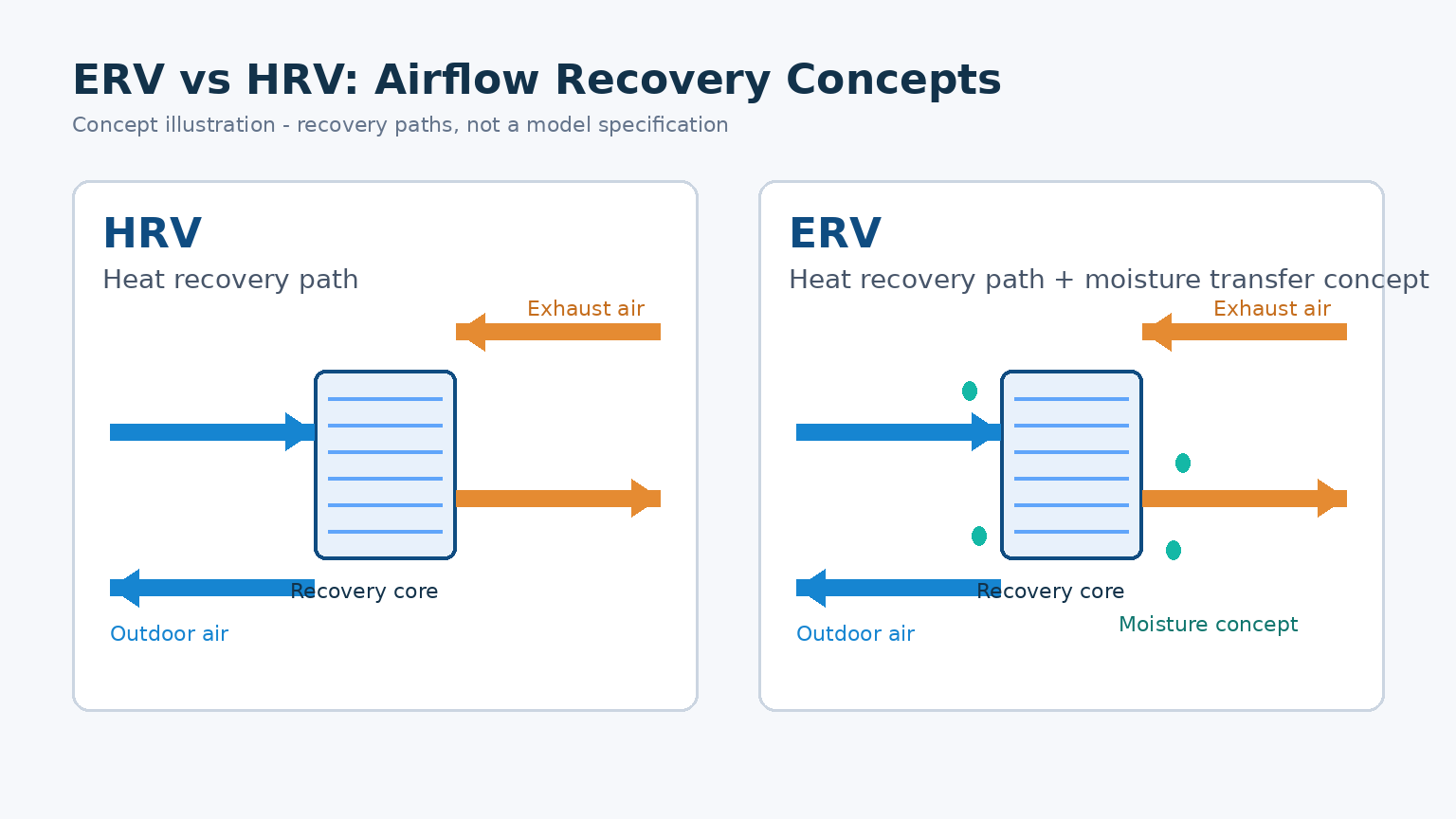
An ERV and an HRV both bring outdoor air in while exhausting stale indoor air. The practical difference is what each recovery core transfers: an HRV focuses on

Рекуперация энергии или тепла: какая система вентиляции подходит вашему зданию?
An ERV system and an HRV both bring outdoor air in while exhausting stale indoor air. (The pair is searched under several names — HRV ERV, ERV vs HRV, energy recovery ventilation — but the comparison is the same.) The practical difference is what each recovery core transfers: an HRV focuses on heat, while an ERV transfers heat and a portion of moisture. The right starting point is the building’s climate, moisture conditions, occupancy pattern, and duct layout, not a generic product label.
Quick Answer: Choose the system category after defining whether humidity transfer matters for the building. An HRV is a heat-recovery ventilation approach. An ERV is an energy-recovery ventilation approach that also considers moisture transfer. Exact equipment selection still depends on the published model data, local design requirements, duct routing, electrical supply, and the project’s indoor-air objectives.
What both systems do
Both systems use separate supply and exhaust air paths. Outdoor air enters the building while stale indoor air leaves it. A recovery core lets energy move between those paths without simply mixing the two airstreams.
For a buyer, this creates a clearer question than “Which unit is better?” Start by defining the building use, occupancy, outdoor conditions, indoor moisture concern, and available installation route. Those inputs determine which product family deserves closer review.
The difference between HRV and ERV
An HRV is commonly used to describe ventilation equipment that recovers sensible heat between outgoing and incoming airstreams. In simple terms, it helps retain temperature energy that would otherwise be exhausted.
Система ERV обычно используется для описания вентиляционного оборудования, которое передаёт как тепло, так и часть энергии влаги. Это делает условия влажности частью обсуждения выбора наряду с расходом воздуха, сопротивлением воздуховодов и монтажным пространством.
Это различие носит концептуальный характер. Оно не заменяет точный лист данных модели. Не предполагайте, что обозначение семейства доказывает конкретное значение расхода воздуха, эффективность рекуперации, электрическую конфигурацию или объём документа.
Начинайте со здания, а не с названия оборудования
Используйте эти вопросы, чтобы задать рамки обсуждения выбора:
- Проект представляет собой одну комнату, жилое помещение или более крупную коммерческую зону?
- Нужно ли команде здания учитывать влажность внутри помещения, а также температуру?
- Какие наружные условия влияют на проект при нормальной эксплуатации?
- Где могут проходить приточные и вытяжные воздуховоды?
- Каким требованиям по целевому расходу воздуха, электропитанию и монтажным ограничениям должна соответствовать окончательная модель?
Эта последовательность помогает не выбирать категорию вентиляции до того, как условия объекта станут ясны.
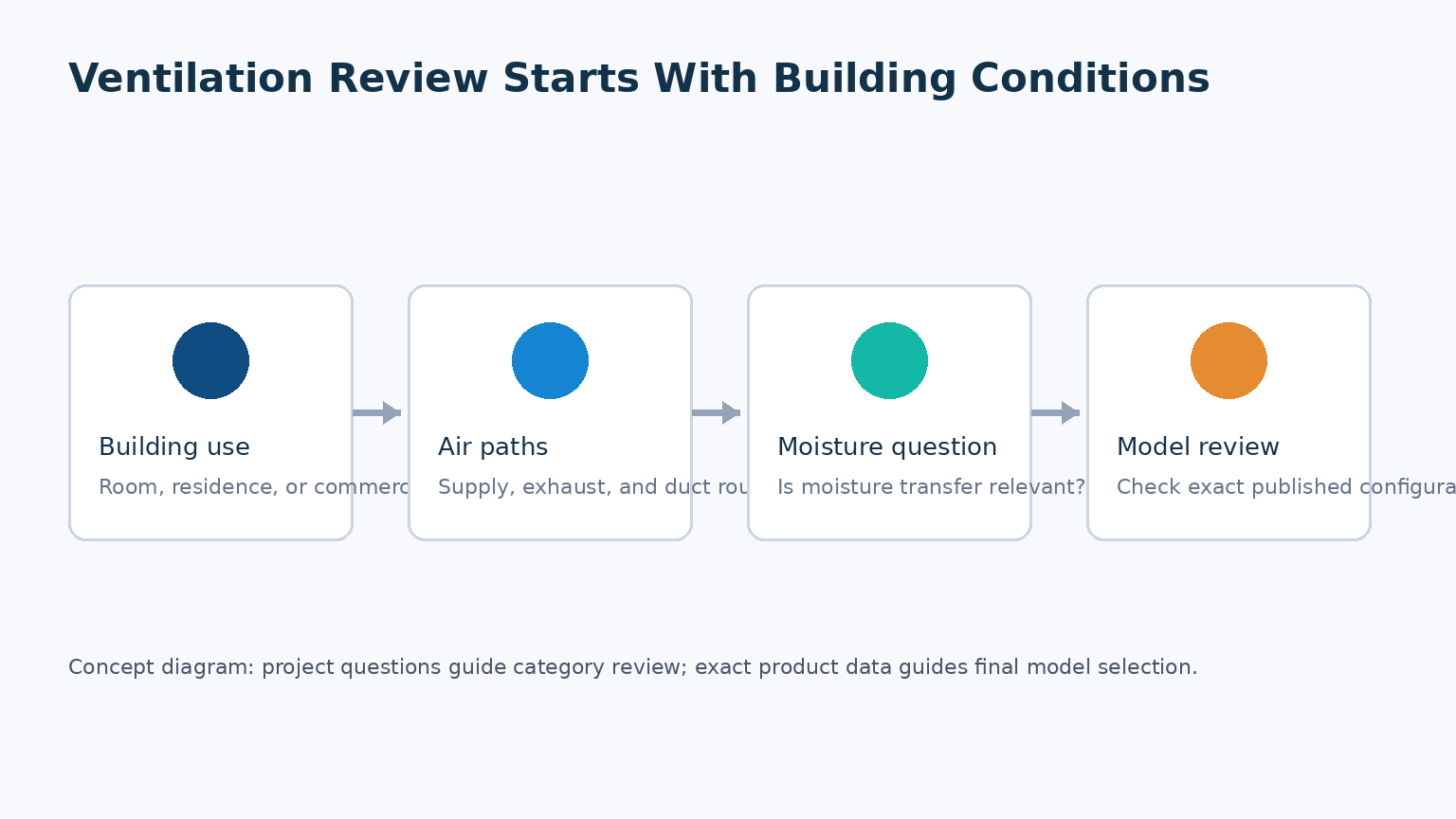
Иллюстрация концепции: вопросы по зданию направляют рассмотрение категорий. Точные данные продукта остаются окончательным источником для выбора модели.
Когда рассматривать вариант HRV для одной комнаты
Вариант для одной комнаты актуален, когда вентиляция планируется по комнатам, а не через одну более крупную центральную систему. Страница каждого продукта — правильное место для проверки доступной конфигурации и её опубликованных данных.
Изучите, Single-Room HRV Selection Hub чтобы сравнить текущие опубликованные варианты продуктов для отдельных комнат. Для примера на уровне модели ознакомьтесь с страницей продукта VT501-WiFi Single Room HRV и перед составлением коммерческого предложения сверьте с проектом версию управления.
Published single-room HRV examples
The Linggongshare product database records distinct single-room HRV model paths. These are examples for identity and published configuration review, not a substitute for a project calculation.
| Model path | Published airflow settings | Published supply field | Source boundary |
|---|---|---|---|
| VT100 / VT100-WF | 20, 30, 40, 50 m³/h | 100-240 V | KCVENTS Single Room HRV product record |
| VT125 / VT125-WF | 20, 30, 45, 60 m³/h | 12 VDC / 100-240 V | KCVENTS Single Room HRV product record |
| VT501 family | 20, 48, 54, 60 m³/h | 12 VDC / 100-240 V | KCVENTS Single Room HRV product record |
Use the exact product page and project conditions to confirm the applicable configuration. Do not transfer these values to an ERV family or to a differently named variant without model-level evidence.
When to review an ERV route
An ERV route is relevant when the project needs to assess heat and moisture transfer as part of a broader ventilation plan. The final choice should be confirmed against the exact product page and project conditions rather than inferred from the term “ERV.”
Изучите, Energy Recovery Ventilator Selection Hub for commercial, residential, and inline product paths. Send the application, target airflow, installation type, duct route, electrical supply, humidity concern, quantity, and destination market to request a focused review.
A simple decision path
- Define the building area and the ventilation objective.
- Identify whether humidity transfer needs to be part of the discussion.
- Рассмотрите подходящий вариант продукции HRV или ERV.
- Check the exact model’s published information before specifying it.
- Send the project inputs needed for model confirmation.
What to confirm before requesting a quote
A useful inquiry includes the building application, target airflow, installation type, duct route, available electrical supply, indoor moisture concern, quantity, and destination market. This gives the review team the information needed to route the request to an appropriate published product family and then assess the exact model.
Request an ERV or HRV project review
FAQ
What is the main difference between an ERV and an HRV?
An HRV is generally discussed as a heat-recovery ventilation approach, while an ERV includes heat and moisture transfer in the selection discussion. That distinction helps frame the project, but it does not establish the performance of a specific model. Review the exact product information before making a specification decision.
Is an ERV always better than an HRV?
No. The correct route depends on the building’s climate, indoor moisture concerns, ventilation objective, duct arrangement, and the available product configuration. Treat ERV and HRV as two categories for the initial conversation. The exact model still needs to be matched to the project’s stated requirements.
Can a single room use heat-recovery ventilation?
A single-room ventilation route can be relevant when the project is planned room by room. Start with the room use, installation location, airflow need, and practical wall or duct constraints. Then review the published single-room product paths and request a model-specific review using the actual project inputs.
What details should I send for an ERV or HRV review?
Send the application, target airflow, installation type, duct route, available electrical supply, humidity concern, quantity, and destination market. These inputs help establish the correct product route and identify which exact model information must be checked before a quotation or project submission.
Plain summary
ERV and HRV systems both replace stale indoor air with outdoor air while recovering energy from exhaust air. The key difference is moisture transfer. Start with the building conditions and project inputs, then review an exact product route before choosing a model.
 English
  Русский
  Français
  Deutsch
  Italiano