
Вентиляция гроурума: подбор канального вентилятора по объему
How to size an inline fan for a grow room or grow tent: air changes per hour, static pressure through filter and duct, and published DPT model data.

Вентиляция гроурума: подбор канального вентилятора по объему
Grow room ventilation is an air-change calculation with a pressure problem attached. You need to know how much air to move, and then you need enough static pressure to move it through a filter, a duct run and an outlet. Size on airflow alone and the fan will run but not clear the heat and humidity. This guide works through both, with the published inline fan data from this site.
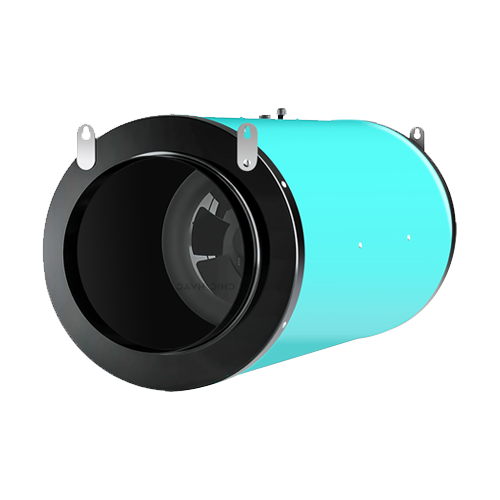
Grow room inline duct fan. The published model range runs from 100 mm to 200 mm duct sizes, which is what most tent and small-room builds use.
Quick Answer: work out the required airflow from the room volume and the air change rate, add margin for the filter and duct, and then choose the model by duct size and static pressure, not by airflow alone. The published inline fan range here covers 230 to 1,200 m³/h in 100 mm to 200 mm duct sizes, with static pressure from 160 to 410 Pa. Most undersized grow room setups fail on pressure, not on airflow.
Note: the values in this guide come from the published inline duct fan data on this site and describe that family. Confirm any specific model against its own datasheet before you order.
Step 1. Calculate the airflow you need
Grow room ventilation is usually expressed in air changes per hour (ACH) because it has to clear heat and humidity, not just supply fresh air. The calculation is room volume multiplied by the target air change rate.
As a worked example: a 1.2 m × 1.2 m × 2.0 m tent is about 2.9 m³. At 30 ACH that is roughly 86 m³/h, and at 60 ACH it is about 173 m³/h. For a small room of 3 m × 3 m × 2.4 m (about 21.6 m³), 20 ACH needs roughly 432 m³/h. Write your own figure down before looking at any model.
Two additions to the raw volume figure. First, hot lighting adds load, so a high-output installation wants a higher air change rate than a low-heat one. Second, an activated carbon filter in the extract path adds real resistance; if you are filtering the exhaust, the pressure requirement rises and the airflow figure alone will not tell you which fan works.
Step 2. Add static pressure for the filter and duct
This is where most grow room setups go wrong. The air has to pass through a carbon filter, along a duct run with bends, and out through an outlet. Every one of those adds resistance, and the fan has to overcome the total. The published static pressure figures for this range run from 160 Pa on the smallest model up to 410 Pa on the largest — and a carbon filter alone can account for a large share of that.
Practical rules: keep the duct run as short and as straight as you can, use the largest duct practical for the airflow, and avoid sharp bends. If your duct run is long, a higher-pressure model at the same airflow will outperform a higher-airflow model at lower pressure.
Step 3. Match duct size and model
Choose the duct size first, because it constrains everything downstream. The published range here covers 100 mm, 150 mm and 200 mm duct connections, and each size comes with its own airflow and pressure figures. The published application-area column is a useful cross-check: the models are published against areas from 8–15 m² up to 40–60 m².
Check four things against the table before selecting: the required airflow, the total static pressure including filter, the duct diameter you will actually fit, and the supply you have. Voltage and frequency are published per model and must match the local supply.
Published inline fan data (reference)
The table below reproduces the published values for the inline duct fan family used in grow room and small-room ventilation. Each model publishes a high and a low gear.
| Модель | Supply | Скорость | Мощность (Вт) | Airflow (m³/h) | Static pressure (Pa) | Noise dB | Duct size | Application area |
|---|---|---|---|---|---|---|---|---|
| DPT10-24H | 220 V / 50 Hz | H / L | 48 / 38 | 230 / 180 | 160 | 25 | ⌀100 mm | 8–15 m² |
| DPT15-34H | 220 V / 50 Hz | H / L | 60 / 45 | 350 / 250 | 220 | 30 | ⌀150 mm | 20–25 m² |
| DPT15-45H | 220 V / 50 Hz | H / L | 84 / 78 | 500 / 420 | 260 | 34 | ⌀150 mm | 25–30 m² |
| DPT20-56H | 220 V / 50 Hz | H / L | 104 / 80 | 920 / 700 | 365 | 38 | ⌀200 mm | 40–47 m² |
| DPT20-66H | 220 V / 50 Hz | H / L | 135 / 103 | 1,200 / 1,050 | 410 | 45 | ⌀200 mm | 40–60 m² |
Source: published inline duct fan data on this site. Airflow and power are shown per gear (H = high, L = low); static pressure and duct size are published per model; the application-area column is the published reference area. These values describe the family and are not a site-specific guarantee.
Reading the table: an example
Back to the 1.2 m × 1.2 m × 2.0 m tent needing about 173 m³/h at 60 ACH. Run your eye down the airflow column. DPT10-24H gives 230 m³/h in high gear through a 100 mm duct, which clears the airflow figure with margin — but check the pressure: 160 Pa is the lowest in the range, and if a carbon filter is in the path that margin may not survive. DPT15-45H gives 500 m³/h at 260 Pa through a 150 mm duct, which leaves far more headroom for filter resistance and a longer duct run, at 34 dB instead of 25 dB. So the question becomes whether the extra noise is acceptable in the space. If the tent is in a living area, the quieter 100 mm model with a short duct may be the better real-world answer; if it is in a utility room, take the pressure headroom. That is a decision the site conditions settle, not the catalogue.
Need this sized for your project?
Send us the room or tent volume, the target air change rate, whether a carbon filter is in the extract path, the duct diameter and run length, and the supply you have. We shortlist the exact model before quotation.
Запросить коммерческое предложение
See the inline duct fan hub →
When an inline fan alone is not the answer
- Very large or multi-room grows: one inline fan per room is the right shape for a tent or small room. A multi-room facility needs a designed system, not a series of single fans.
- Cooling is the real requirement: if heat load is the limiting factor rather than air changes, an air conditioner may be part of the answer alongside ventilation.
- Very long or very bendy duct runs: the higher-pressure models help, but at some point the duct design itself is the problem and should be changed rather than compensated for.
- Odour control is critical: the fan moves the air, but the carbon filter does the odour work. Confirm the filter resistance before choosing the fan. See the filter replacement guide.
Frequently asked questions
How many air changes per hour does a grow room need?
It depends on the heat load and the growing method. Volume multiplied by the target air change rate gives the required airflow. Work the figure out for your own room, then add margin for the filter and duct.
Should I size on airflow or static pressure?
Both. Airflow tells you how much air the fan moves with a free outlet. Static pressure tells you whether it can still move that air once a filter and duct are in the path. Sizing on airflow alone is the most common mistake.
Does a carbon filter change which fan I need?
Yes. A carbon filter adds substantial resistance, so the same airflow requirement may need a higher-pressure model. Factor the filter into the pressure total from the start.
Are the table values final for ordering?
They are published reference values for the family. For ordering, the exact model nameplate data and your project condition govern. The product page carries the full published snapshot.
Спланируйте проект вентиляции с Linggongshare
Linggongshare supplies inline duct fans, mixed-flow fans, filter stacks, HRV units and air curtains for residential, commercial and industrial ventilation. To request a quote, send us the room volume, the target air change rate, the duct design and the destination market. Browse the full product selection hub or the inline duct fan hub, or contact us and we will help you narrow it down.
Published 16 September 2026. Reviewed against the published inline duct fan data.
 English
  Русский
  Français
  Deutsch
  Italiano