
Cabinet Fan Selection: Airflow and Static Pressure
How to choose a cabinet fan for workshops and dust-load air: airflow, static pressure, whether you need a filter box, with published KTJ and DT data.

Cabinet Fan Selection: Airflow and Static Pressure
A cabinet fan is a centrifugal fan built into a box, usually so it can carry a filter, take a square duct connection and sit on a wall or a stand without a separate housing. Choosing one comes down to the airflow and static pressure the airstream needs, whether the duty involves dust or filtration, and the supply and physical size you have available. This guide works through those in order, then sets out the published model data for the cabinet fan families on this site.
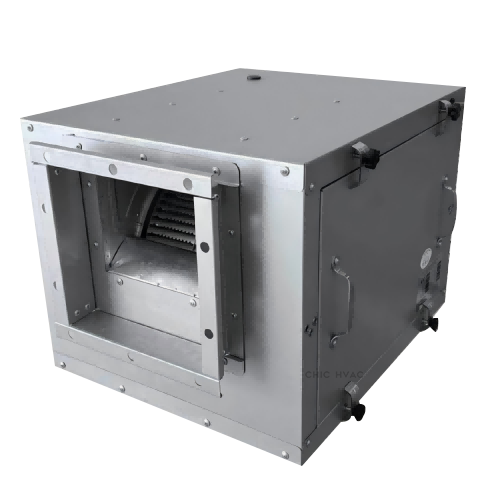
Cabinet / box fan with a square air outlet. The box form is what lets it take a filter box and a square duct spigot without separate fabrication.
Quick Answer: work from the required airflow and the total system resistance, not from the fan size. Cabinet fans in the published families here run from 2,000 m³/h up to 20,000 m³/h and from 400 Pa to 725 Pa of static pressure, with single-phase 220 V options at the smaller sizes and three-phase 380 V at the larger ones. Where the airstream carries dust, the filter-box duty usually decides the model rather than the airflow alone.
Note: the values in this guide come from the published cabinet fan data on this site and describe those families. Confirm any specific model against its own datasheet before you order.
What a cabinet fan is used for
The cabinet form exists for three reasons. It can hold a filter element, which turns the fan into a filtered supply or exhaust unit. It presents a square face, which suits square duct and wall openings. And it is self-contained, so it can be wall-mounted or stand-mounted without a fabricated housing.
In practice that makes cabinet fans the natural choice for:
- Filtered fresh-air supply into workshops, plant rooms and workshops with airborne dust
- Exhaust from process areas where the fan has to overcome filter and duct resistance
- General industrial air movement where a compact, wall-mountable unit is wanted
- Dust-load duties, where the fan and filter work as one unit
How to select a cabinet fan
Step 1. Define the required air volume (m³/h)
Start from the air change rate or the process capture requirement. Air changes per hour multiplied by room volume gives the hourly air volume. If the design is not final, express it as a range and size on the upper end, because a fan chosen at exactly the duty has no margin for a loaded filter.
Step 2. Estimate the total static pressure (Pa)
Add the resistance of the whole air path: duct, bends, transitions, grilles and, above all, the filter. A clean filter and a loaded filter are very different pressures, and sizing on the clean figure is the classic mistake. This is where cabinet fans earn their place — the published families here carry 400 to 725 Pa, which is what a filtered path needs. Underestimating this is the most common reason a fan runs but does not extract.
Step 3. Decide whether you need a filter box
If the duty is filtered supply, or the airstream carries dust or lint, the filter is part of the fan selection, not an accessory. A cabinet fan that takes a filter element lets the two be matched at the factory. If there is no filtration duty, a plain cabinet or box fan is the simpler and cheaper buy.
Step 4. Match supply and motor
The smaller cabinet models publish single-phase 220 V versions and the larger ones three-phase 380 V. Confirm the supply you actually have: higher airflow and pressure duties are normally three-phase, so the available supply often sets the ceiling on the model range before anything else does.
Step 5. Check noise and physical size
Published dB(A) runs from about 55 dB(A) on the smaller models up to about 77 dB(A) on the largest. In an occupied area, choose on noise as well as duty; in a plant room, duty comes first. Then confirm the outlet and inlet sizes and the overall box dimensions against the space and the ductwork already in place.
Published cabinet fan data (reference)
The table below reproduces the published values for the cabinet fan families on this site. Airflow and static pressure are given as published; noise is a published dB(A) figure.
| Family | Модель | Voltage | Мощность (Вт) | Airflow (m³/h) | Static pressure (Pa) | Noise dB(A) |
|---|---|---|---|---|---|---|
| KTJ (box / IP55) | KTJ23-20 / -20D | 380 V / 220 V | 250 | 2,000 | 400 | 55 |
| KTJ (box / IP55) | KTJ23-26 / -26D | 380 V / 220 V | 370 | 2,600 | 420 | 56 |
| KTJ (box / IP55) | KTJ23-31 / -31D | 380 V / 220 V | 550 | 3,100 | 440 | 61 |
| KTJ (box / IP55) | KTJ23-41 / -41D | 380 V / 220 V | 750 | 4,100 | 460 | 65 |
| KTJ large | KTJ28-51 | 380 V | 750 | 5,100 | 400 | 67 |
| KTJ large | KTJ28-61 | 380 V | 1,100 | 6,100 | 420 | 68 |
| KTJ large | KTJ31-71 | 380 V | 1,500 | 7,100 | 440 | 69 |
| KTJ large | KTJ31-81 | 380 V | 1,500 | 8,100 | 461 | 70 |
| KTJ large | KTJ35-100 | 380 V | 2,200 | 10,000 | 551 | 71 |
| KTJ large | KTJ35-120 | 380 V | 2,500 | 12,000 | 591 | 72 |
| KTJ large | KTJ40-150 | 380 V | 3,000 | 15,000 | 700 | 75 |
| KTJ large | KTJ40-200 | 380 V | 5,000 | 20,000 | 725 | 77 |
| DT high pressure | DT28-6000 | 380 V | 1,500 | 6,500–4,800 | 520–710 | 64 |
| DT high pressure | DT30-8000 | 380 V | 2,200 | 8,500–6,500 | 640–740 | 67 |
| DT high pressure | DT30-10000 | 380 V | 3,000 | 10,500–8,500 | 720–800 | 70 |
| DT high pressure | DT32-12000 | 380 V | 4,000 | 12,500–9,000 | 740–850 | 73 |
Source: published cabinet fan (KTJ) and high-pressure cabinet fan (DT) data on this site. The KTJ rows combine the box fan and IP55-motor variants, which share the same published airflow and pressure and differ in motor protection and voltage version; the “/ -D” suffix denotes the 220 V model. DT airflow and pressure are shown as the published operating range. These values describe the families and are not a site-specific guarantee.
Reading the table: an example
Say a workshop needs about 3,000 m³/h through a filtered supply path with roughly 500 Pa of total resistance, on a 380 V three-phase supply. Run your eye down the table. KTJ23-31 delivers 3,100 m³/h at 440 Pa on 550 W, which is close but a little light on pressure against a 500 Pa duty. KTJ23-41 gives 4,100 m³/h at 460 Pa on 750 W. If the resistance is dominated by a filter that will load over time, KTJ28-51 gives 5,100 m³/h at 400 Pa, but its pressure is lower, so it is the wrong answer for a high-resistance path. If the duty really is high resistance, the DT high-pressure family is the right shape: DT28-6000 gives 6,500–4,800 m³/h at 520–710 Pa. Which one is right depends on whether your constraint is airflow, pressure, or the supply you have.
Need this sized for your project?
Send us the required airflow, the total static pressure including the filter, the supply voltage, the inlet and outlet sizes and the space available. We shortlist the exact model and confirm the duty point before quotation.
Запросить коммерческое предложение
See the cabinet fan hub →
When a cabinet fan is the wrong choice
- Low resistance, high airflow: an axial or mixed-flow fan usually moves more air per watt. The inline duct fan hub covers ducted lower-pressure duties.
- Explosive or corrosive airstreams: standard models are not specified for these. Material and motor protection have to be confirmed for the application.
- Silence is the dominant requirement: at 55–77 dB(A) these are plant-room units. In an occupied space, a larger low-speed fan or acoustic treatment is normally the better answer.
- Very small duties: below roughly 2,000 m³/h a cabinet fan is oversized. Look at the exhaust or inline fan families instead.
Frequently asked questions
Do I need a filter box with a cabinet fan?
Only if the duty is filtered supply or the airstream carries dust or lint. Without a filtration duty, a plain cabinet or box fan is simpler and cheaper. With one, the filter resistance belongs in the pressure calculation from the start.
Should I size on clean or loaded filter pressure?
Size with margin for the loaded condition, not the clean one. A fan selected at the clean-filter pressure will lose airflow as the filter loads, which is the classic “runs but does not extract” complaint.
Why do the larger cabinet fans need three-phase supply?
Higher airflow and pressure duties draw more power, and the published families move to three-phase 380 V at the larger sizes. If the site only has single-phase, that sets the practical ceiling on the model range.
Are the table values final for ordering?
They are published reference values for the families. For ordering, the exact model nameplate data and your project condition govern. Each product page carries the full published snapshot.
Спланируйте проект вентиляции с Linggongshare
Linggongshare supplies cabinet fans, centrifugal fans, duct fans, exhaust fans, air curtains, dehumidifiers and heaters for industrial ventilation. To request a quote, send us the required airflow, static pressure, supply voltage, duct sizes and destination market. Browse the full product selection hub or the cabinet fan hub, or contact us and we will help you narrow it down.
Published 16 September 2026. Reviewed against the published KTJ and DT cabinet fan data.
 English
  Русский
  Français
  Deutsch
  Italiano