
HEPA- und Kohlenstofffilter wechseln: wann und wie
When to replace HEPA and activated carbon filter stages: what each layer catches, the signs it is loaded, and published reference data for the stack.

HEPA- und Kohlenstofffilter wechseln: wann und wie
A three-layer filter stack does three different jobs, and the three layers do not wear out at the same rate. The pre-filter catches the coarse material, the HEPA layer catches fine particles, and the activated carbon layer handles odours and gases. Replacing them on one schedule wastes money; replacing them too late costs airflow. This guide sets out what each layer does, how to tell when it is loaded, and the published data for the stack.
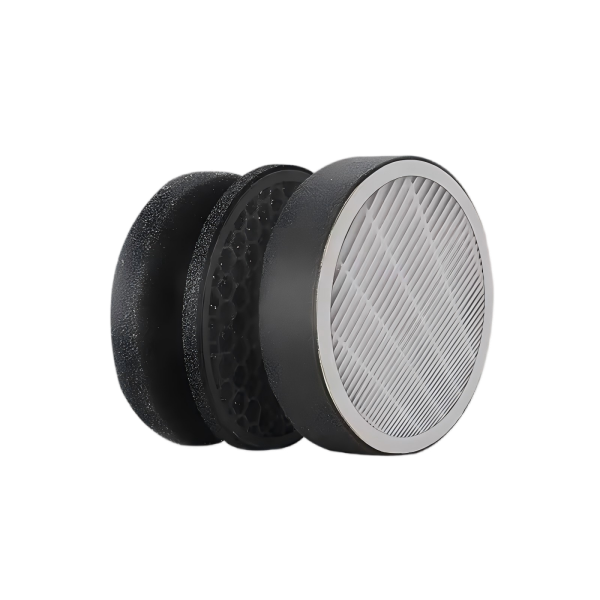
Three-layer filter stack: pre-filter, HEPA, then activated carbon. The pre-filter protects the other two, which is why its condition drives the whole replacement cycle.
Quick Answer: check the pre-filter first and most often, because it is the cheapest layer and it protects the other two. Replace the HEPA and carbon stages when airflow drops noticeably, when odour control stops working, or on the manufacturer’s interval — whichever comes first. The stack itself is a pre-filter, a HEPA filter and an activated carbon filter, and any replacement must be confirmed against the unit it fits before ordering.
Note: the values in this guide come from the published filter data on this site and describe that product family. Confirm compatibility with your specific unit before you order.
What each of the three layers does
Pre-filter
The pre-filter is the first stage, and its job is to catch the coarse material — the published function is filtering particles such as mould and spores. It is the layer that protects the other two, and it is the one that loads fastest. Because it is the cheapest layer to replace, changing it on time is what keeps the HEPA and carbon stages working to their full life.
HEPA layer
The HEPA layer catches fine particles: the published function is filtering dust, smoke and PM2.5 through a high-density filter. A HEPA layer loads from the inside out, so its restriction builds gradually. By the time you can see that it is dirty, it has usually been costing airflow for a while. That is why the airflow reading, not the appearance, is the better indicator.
Activated carbon layer
The activated carbon layer handles what the mechanical stages cannot: the published function is helping to eliminate indoor odour and formaldehyde. Carbon does not clog the way a HEPA layer does; it becomes saturated. That means it can look perfectly clean and still have stopped working. Odour returning is the practical signal, not a visual one.
Why the layers do not wear out together
Three different mechanisms, three different lifetimes. The pre-filter loads mechanically and fastest. The HEPA layer loads mechanically but slowly, and is protected by the pre-filter. The carbon layer saturates chemically and gives no visual warning. A single “change the filter” interval treats three different clocks as if they were one, which in practice means either throwing away good HEPA media or running saturated carbon.
There is also an airflow cost to leaving any stage in too long. A loaded filter raises the resistance of the whole air path, and the fan behind it then moves less air at the same speed. That is the same mechanism that makes a ventilation system “run but not extract”, and it is worth checking the exhaust fan sizing guide if the fan is ducted.
Signs a filter layer needs attention
- Noticeably weaker airflow from the supply or exhaust at the same fan setting — the classic loaded-filter sign.
- Odour returning to a space that was previously odour-free — the carbon layer is saturated, even if it looks clean.
- Visible dust build-up on the pre-filter face — the pre-filter is doing its job and is ready for replacement.
- The fan sounding strained, or running continuously without hitting target — increased system resistance.
- Allergy or irritation complaints returning in a space that previously felt fine — the fine-particle stage is no longer performing.
Published filter data (reference)
The table below reproduces the published values for the three-layer filter stack on this site, together with the compact filtration unit that uses it.
| Position | Published value | Buyer check |
|---|---|---|
| Filter layers | Pre-filter / HEPA filter / activated carbon filter | Confirm compatible unit and required airflow before order |
| Pre-filter function | Filters particles such as mould and spores | Confirm filter fit and replacement requirements for the target unit |
| HEPA function | Filters dust, smoke and PM2.5 through a high-density filter | Confirm the target unit and airflow resistance before selection |
| Activated carbon function | Helps eliminate indoor odour and formaldehyde | Confirm the air-treatment requirement and compatible unit before selection |
| Use condition | Confirm compatible unit and airflow resistance | Buyer-side fit check |
Source: published three-layer filter data on this site. These are the published functions of each layer and the fit checks that apply; they describe the family and are not a site-specific performance guarantee.
The compact powered unit in the same fresh-air accessory range publishes the following values, and takes filtration of this kind:
| Spec item | Source value | Buyer check |
|---|---|---|
| PDF model code | KC-PMO6HB1 | Confirmed from source page; keep the exact code |
| Voltage | 220 V / 50 Hz | Confirm local supply |
| Noise | 20–30 dB | Low-noise; suited to occupied rooms |
| Luftvolumenstrom | 60 m³/h | Match to the room and filtration duty |
| Stromversorgung | 8 W | Continuous-running cost is low |
| Net weight / size | 2.6 kg / 260×260×80 mm | Check the wall space and opening |
Source: published air filtration box data on this site. The model code and values come from the source product page; confirm the exact unit and its filter fit before ordering.
How to plan the replacement
Plan the three layers on separate intervals and write them down. As a working method:
- Pre-filter: the shortest interval, checked most often. It is the cheap layer that protects the expensive ones.
- HEPA layer: the middle interval, guided by airflow loss rather than appearance.
- Carbon layer: driven by odour performance, which means you cannot judge it by eye.
Confirm three things before ordering any replacement: that the filter physically fits the target unit, that its airflow resistance suits the fan behind it, and that the replacement matches the layer you actually need to change. Buying a full stack when only the pre-filter is loaded is the most common waste.
Need the right filter for your unit?
Send us the unit you are fitting, the airflow it handles, which layer is loaded, the quantity and the destination market. We confirm the compatible stack before quotation.
When a filter stack is not the right answer
- The source of the odour or dust is not controlled: filtration treats the air, it does not stop the source. Fix ventilation and containment first.
- Very heavy particulate loads: workshop dust and welding fume need a dedicated extraction design, not a compact filter stack.
- Grease or oil in the airstream: kitchen and process grease needs filtration and materials that a standard stack is not specified for.
- The unit itself is undersized: if the fan cannot move the required air, a clean filter will not fix it. Check the single-room HRV selection guide for how to size the unit first.
Häufig gestellte Fragen
How often should I change a HEPA filter?
There is no single interval that fits every site. Use the manufacturer’s interval as a starting point, then bring it forward if airflow drops noticeably, if the space gets dustier, or if the pre-filter is loading faster than expected.
Can I clean a HEPA filter instead of replacing it?
It depends on the filter and the unit. Many HEPA layers are not designed to be washed, and washing can damage the media. Confirm with the unit documentation before cleaning rather than replacing.
Why does the carbon layer stop working while still looking clean?
Carbon removes odours and gases by adsorption, which saturates the media chemically. It gives no visual warning, which is why returning odour, not appearance, is the signal to replace it.
Does a dirty filter really reduce airflow that much?
Yes, and it is one of the most common causes of a ventilation system that runs but does not perform. A loaded filter raises the resistance of the air path, so the fan moves less air at the same setting.
Plan your filtration with Linggongshare
Linggongshare supplies three-layer HEPA/carbon filter stacks, filtration boxes, fresh-air valves, HRV units, duct fans and accessories. To request a quote, send us the unit you are fitting, the airflow it handles, which layer needs replacing and the destination market. Browse the full product selection hub or the filter hub, or contact us and we will help you narrow it down.
Published 16 September 2026. Reviewed against the published three-layer filter and air filtration box data.
 English
  Русский
  Français
  Deutsch
  Italiano